Liposuction
Liposuction
For patients with excess submental fat, neck liposuction using tumescent anesthesia will dramatically improve the cervicomental angle and create a pleasing contour. The principles of body liposuction apply to neck liposuction with some minor modifications. Because of the greater vascularity of the neck, a tumescent solution of 0.1% lidocaine with 1/500,000 epinephrine is generally used. Smaller cannulas, mostly 14- to 16-gauge cannulas are more appropriate, though 12-gauge cannulas may be used with caution, and may be more effective in men who have slightly more fibrotic fat.
The patient should be placed in a supine position with a towel roll or pillow under his or her neck to give better exposure to the submentum and neck. For patient comfort, oral sedation can be administered an hour prior to the procedure. Using either an infiltrating cannula, or a 20-gauge spinal needle, the anesthesia is infiltrated. Stab incisions should be made in the submental crease and bilateral infrauricular below the angle of the mandible. Using a 16-gauge cannula, and grasping fat with the “smart hand,” the cannula is inserted into the subcutaneous plane. The strokes should be in a crisscrossing pattern. This is followed by the 14-gauge cannula in a similar pattern, and gently sweeping up to mandible. The submentum and the neck are then approached in a similar fashion from the lateral infrauricular stab incisions. A thin layer of fat should be maintained to reduce the risk of dimpling. A compression garment is worn. While there will be bruising and swelling, recovery time is generally 3 to 4 days. It is felt that neck liposuction works by not only the removal of fat, but by “gently” traumatizing the dermis and the platysma muscle, which will result in contraction of the skin. Anecdotally, there may be more skin tightening in female patients, and in one study, patients over the age of 40 did not experience less skin tightening after liposuction.9 Final results may take up to 6 months.
True contraindications for neck liposuction are few, but include patients who are on blood thinners. Complications include hematoma, infection, dimpling, asymmetry, numbness, and motor nerve injury. The marginal mandibular nerve is at risk, particularly in individuals with submental fullness but a thin neck. Particular caution needs to be paid when sweeping close to the mandible and in the region of the submandibular gland which can also be traumatized and cause postoperative swelling. If the marginal mandibular nerve is injured, it may result in a palsy and asymmetric smile for 6 to 8 weeks. Fortunately, since the nerve will be bruised and not severed with a blunt cannula, the injury is temporary, but can cause significant stress to the patient. Aggressive liposuction of the neck can also cause a pseudopalsy of the marginal mandibular nerve which is due to trauma to the cervical branches of the facial nerve. This is also temporary and generally not as severe as a true injury to the marginal mandibular nerve. Aggressive submental liposuction can also result in a concavity which is not aesthetically pleasing (Fig. 79-3).
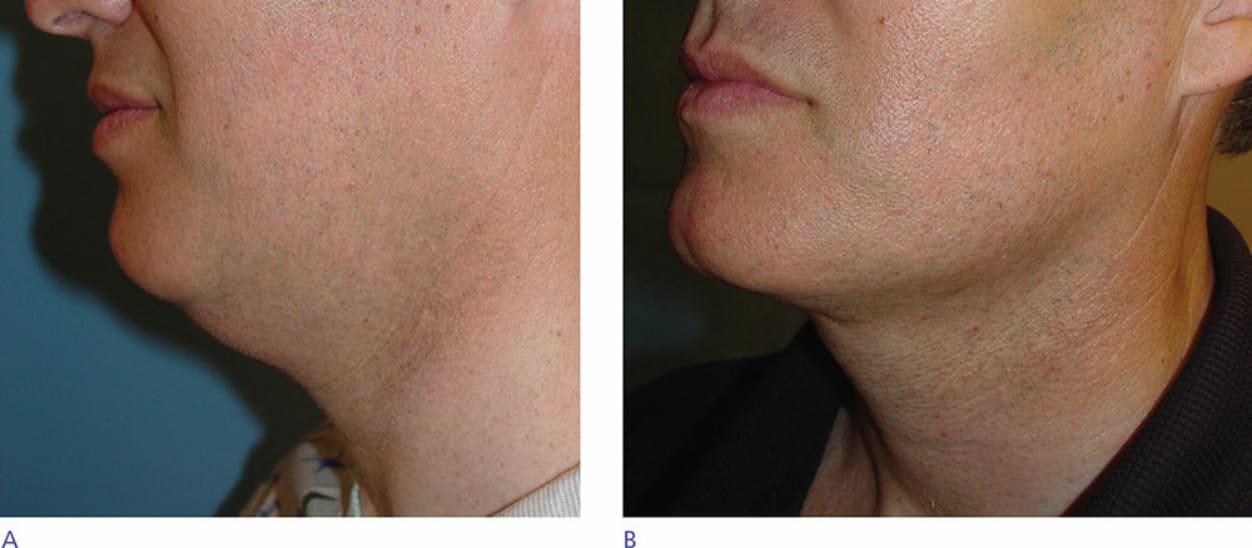
Figure 79-3. Neck liposuction. (A) Before. (B) Three months postprocedure.