Glycolic acid solution
Glycolic acid solution
Glycolic acid is the most popular α-hydroxy acid used for chemical peels. As the α- hydroxy acid with the smallest molecular size, it is thought to have better penetration compared to other compounds. Even though it is a naturally occurring compound found in sugar cane, clinical formulations are typically synthesized. It is provided as a crystalline solid, which must first be dissolved and then applied to the skin. The formulations can vary greatly in concentration, pH and vehicle, and the clinician should be aware of these factors as they all affect its efficacy. As the concentration of glycolic acid increases, so does penetration and tissue wounding.5,6 The free form of glycolic acid causes greater tissue damage compared to partially neutralized or esterified formulas at the same concentration (Table 78-2).5 Formulations in an aqueous solution have greater bioavailability and penetration compared to gel formulation.7
There are numerous formulations marketed to the consumer as part of a daily regimen, ranging in concentration from 8% to 20%.7 In concentrations of 3% to 13% applied twice daily, glycolic acid has been shown to improve xerotic skin’s texture and moisturization.8 At these low concentrations, glycolic acid decreases corneocyte cohesiveness by reducing sulfate and phosphate groups, leading to exfoliation and a superficial peel. Stronger glycolic acid peels such as the 50% and 70% formulation are typically applied in the clinicians’ office. At these higher concentrations, glycolic acid can induce subepidermal vesiculation with dermal inflammation, resulting in the induction of new dermal collagen and ground substance as the skin heals.5,6
No preparatory agent is used prior to applying the peeling agent. Patients will experience stinging and irritation with application of the glycolic acid peel, but tolerability can be improved with a hand-held cooling fan. The endpoint for this peel is a uniform level of erythema, which is typically achieved in 2 minutes, though the peel may be left in place up to a limit of 5 minutes. If regions of the skin start to blanch or frost, this may be an indication of deeper penetration and epidermolysis, and the peel should be stopped with neutralization. To neutralize the glycolic acid peel, either a bicarbonate solution or cool water can be used. If a bicarbonate solution is used, patients should be told to expect fizzing and warmth during the exothermic reaction. Glycolic acid peels can also be neutralized with water to avoid the reaction, but any remaining solution must be completely rinsed away to completely remove the acid.
Glycolic acid, like salicylic acid, is generally well tolerated and can be used in a wide range of Fitzpatrick skin types, but unlike salicylic acid, the penetration can be less predictable at higher concentrations.9 To minimize the risk of a deeper peel than intended, patients can be asked to stop topical retinoids 3 to 7 days prior to their peel, since tretinoin can lead to a dermatitis and deeper penetration of the glycolic acid. If deeper penetration does occur, patients may experience essentially a medium depth peel with increased erythema, edema, desquamation, and a prolonged healing time. Inflammatory conditions such as seborrheic dermatitis may cause uneven and deeper penetration and skin affected by these conditions must be treated cautiously. Care should also be taken in how many applications and how long the solution is applied as these can both increase the wound depth. A practical approach to the treatment-naïve patient
is to start with a 50% concentration with short contact time and progressively increase at subsequent treatments as tolerated. If a superficial peel is achieved, any postprocedure hyperpigmentation or hypopigmentation should be transitory. Nevertheless, patients should always be counseled on proper sun protection, as glycolic acid acts as a photosensitizer.10 In addition to the risk for pigmentary changes, a small number of patients may experience a perioral acneiform dermatitis, in which case further peels on the chin should be avoided.7
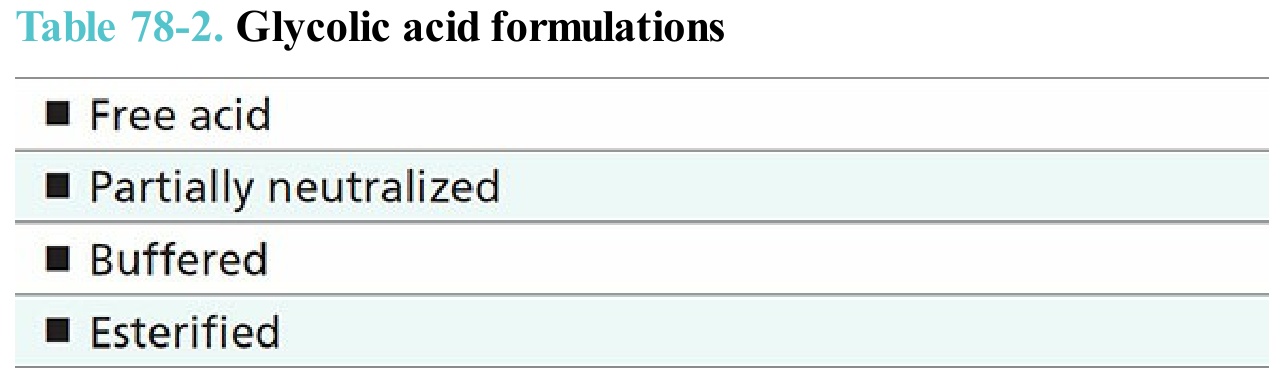
Table 78-2. Glycolic acid formulations