Filler
Filler
The glabellar region is the area most vulnerable to arterial occlusion and ensuing blindness with filler injection. Use of blunt cannulas and a thorough knowledge of injection anatomy may help to reduce this risk. Some injectors prefer to use needles, injecting superficially in the intradermal space to address superficial static rhytides and minimizing the risk of cannulating a vessel such as the supratrochlear artery. Threading or serial microdroplets are suggested placement techniques. Deep filler placement in the subgaleal plane using a cannula can help to volumize and lift the tissue, giving an aesthetically pleasing contour. Filler selection depends on the depth of product placement. HA products with lower viscosity and minimal lift capacity are desirable for superficial placement. Juvederm Volbella, Juvederm Ultra, Restylane Refyne, Restylane Fynesse, and Belotero Balance are a few examples. Deeper volumizing placements are best achieved with HA products such as Juvederm Volift, Juvederm Ultra Plus, Restylane Defyne, and Belotero Intense.
Deeper HA filler placement may be carried out using a blunt 25-gauge cannula. Midline or lateral forehead as well as lateral brow entry points may be used, depositing filler with a fanning, threading, or microaliquot technique while avoiding the supraorbital and supratrochlear notch. If sharp needle injections are desired, a 30-gauge or smaller needle is recommended. One approach with cannulas is to enter 2 cm above the orbital rim in the midline forehead, injecting subcutaneously to minimize the risk of
traumatizing the neurovascular bundle located within the frontalis aponeurosis.
Superficial filler placement is best accomplished with serial sharp needle injections utilizing anterograde or retrograde threading or microaliquot deposits.
Botulinum toxin Treatment of the glabellar region is best performed in the context of the entire glabellar– forehead complex in order to achieve optimal results. Onabotulinumtoxin A was approved in 2002 by the FDA for the treatment of glabellar rhytides.42 A consensus group recommends an equivalent of 12 to 40 total units of intramuscular onabotulinumtoxin A. Doses as low as 8 units might be appropriate in some patients. Injection points can vary between three to seven sites targeting the procerus, corrugator supercilii, orbicularis oculi, and depressor supercilii muscles. Dosing and injection sites are best determined by assessing muscle bulk and activity, respectively. Thus, individuals with hypertrophic muscles will require higher dosing than those with less well-developed musculature. Clutching the procerus and supercilii muscles between the thumb and index finger of the nondominant hand helps to isolate these muscles, allowing for more accurate neuromodulator placement. Many injectors advocate injecting 1 cm above the orbital rim in order to prevent orbital diffusion leading to upper-eyelid ptosis.
A meta-analysis of seven clinical trials involving 1,474 participants found that a single treatment using 20 units of BTX-A is safe and effective for glabellar lines. Subgroup analysis confirmed BTX-A could improve static rhytides. The median duration of effect for dynamic wrinkles ranged from 92 to 125 days; a longer median duration of effect for static wrinkles was observed, ranging from 119 to 139 days.43 Another meta-analysis of 16 trials involving 42,405 participants assessed BTX-A adverse effects. In 13 of these studies headaches, eyelid ptosis, and heavy eyelids were reported more commonly in the BTX-A treatment groups (Figs. 75-9 and 75-10).
Precautions, pearls, and pitfalls Avoiding supratrochlear and supraorbital intravascular injections is critical in this region. Use of a cannula for deeper filler placement might be a safer approach.
With filler injections, the highest risk of blindness and changes is in the glabella (38.8%) followed by the nasal region (25.5%), nasolabial area (13.3%), and forehead (12.2%).44
For patients being injected for the first time with BTX-A, starting with conservative dosing to prevent undesirable outcomes such as ptosis of the eyelids and brows and eyebrow splaying is recommended. If necessary, a simple touch-up treatment may be
done at 2 weeks.
Glabellar BTX-A injection patterns can be modified according to the five muscle contraction patterns; namely the “U,” “V,” “omega,” “converging arrows,” and “inverted omega” dynamic wrinkle patterns.45 In Koreans, the patterns described include “U,” “11,” “X,” “π (Pi),” and “I.”46
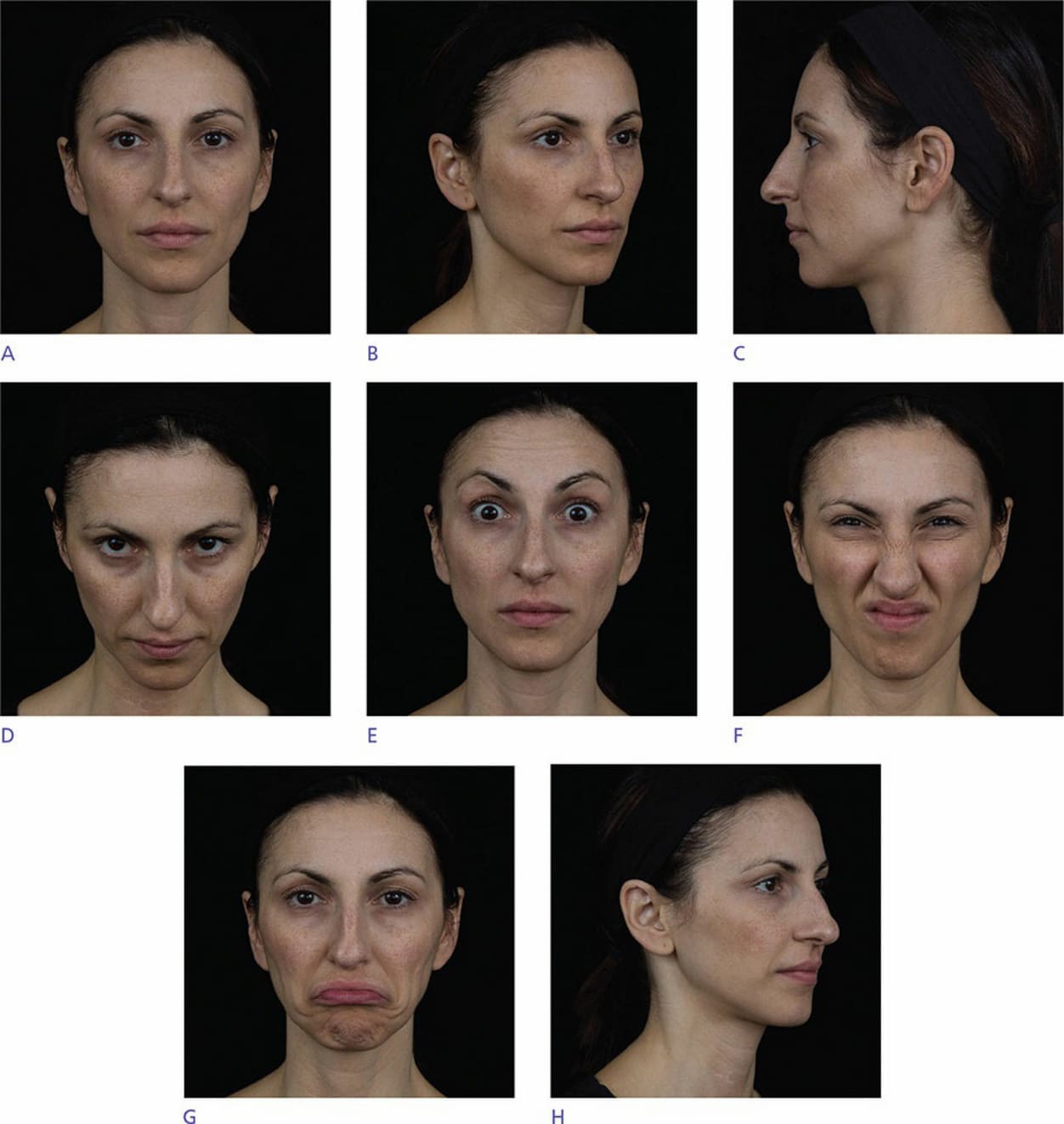
Figure 75-9. Preprocedure photographs.
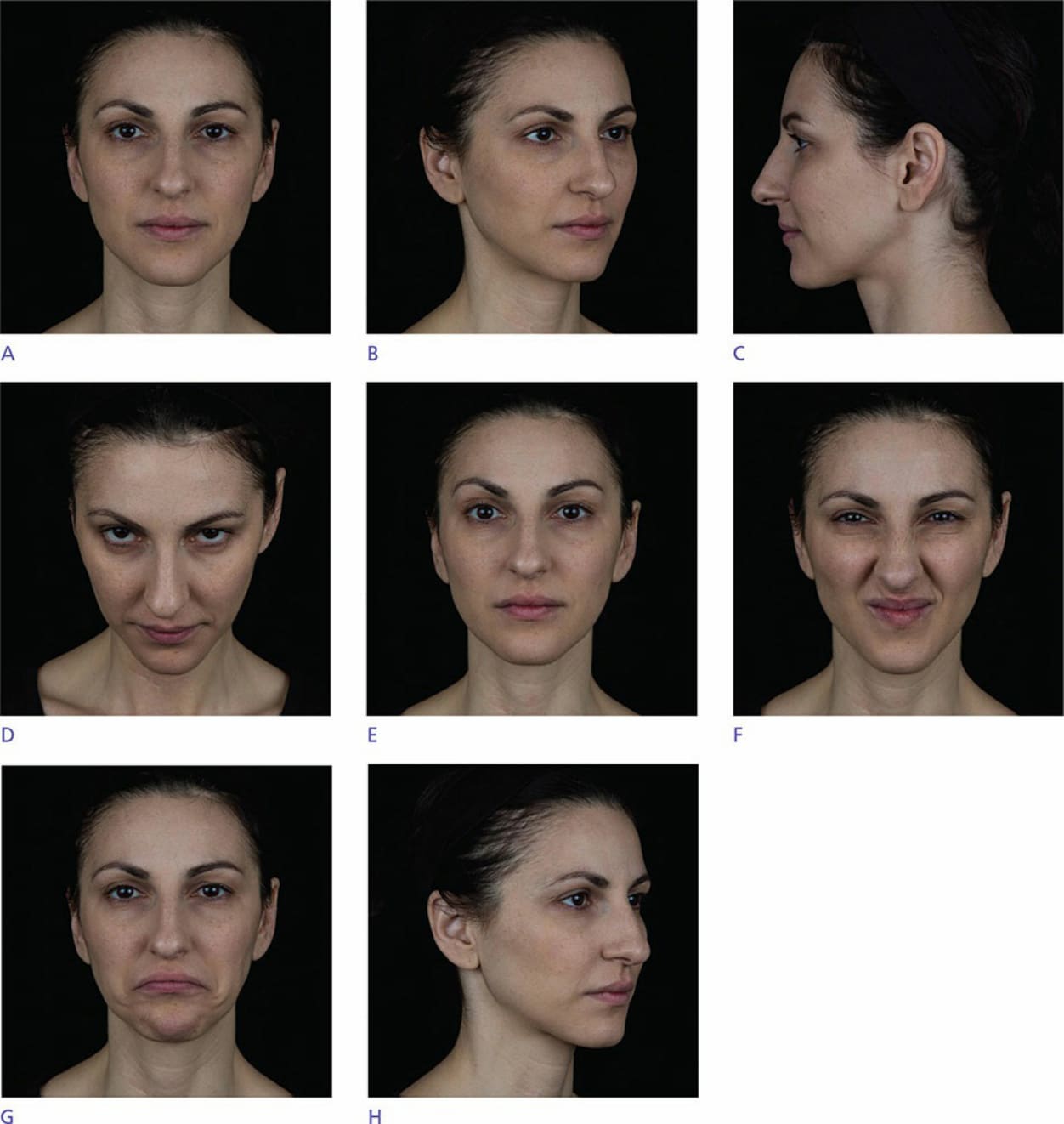
Figure 75-10. After treatment with botulinum toxin in the forehead, glabella, nasalis (bunny lines), lateral canthal rhytides, infraorbital area, and mentalis and fillers in the eyebrows, tear troughs (infraorbital), cheeks (upper and submalar), nose, marionette lines, chin, and angle of mandible.