Introduction
CHAPTER 62 Hair Transplantation
Bessam Farjo Nilofer Farjo Greg Williams
SUMMARY
Androgenetic alopecia, or pattern hair loss, is the most common cause of hair
loss in both men and women, and the most common indication for hair transplant surgery.
There are two basic methods of donor area harvesting: follicular unit extraction
(FUE) and strip follicular unit transplantation techniques (strip FUT).
Beginner Pearls
Hairline design merits precise attention to detail as it will come under the closest
scrutiny from the patient and be most visible to observers.
In a completely bald area, a single procedure can achieve up to 25% to 30% of the
original density; thus, patients often require two procedures to achieve a cosmetically desirable density.
The biggest mistake that is made by beginner hair restoration surgeons is choosing the
wrong patient.
Expert Pearls
The safe donor area for FUE is generally the same as for strip FUT. However, the
harvesting can be extended to other areas, such as the lower neck, if the chance of future loss is remote.
The trichophytic closure technique may help disguise the strip donor scar. A very
superficial string of epidermis (1 × 1 mm) is removed all along the lower or upper wound edge ahead of closure. This has the effect of forcing hairs from this trimmed edge to grow through the scar, breaking up its linear appearance.
Don’t Forget!
FUE uses two basic punch types with sharp and blunt tips; each has manual and power
versions.
Combining strip FUT and FUE can be considered to maximize the number of grafts
obtained from a single procedure.
Generally this approach may increase the single surgery yield by up to 50%.
Pitfalls and Cautions
It is imperative that grafts are placed in an appropriate storage solution as they await
placement back into the scalp. They are very susceptible to trauma and desiccation, and this is probably one of the most common contributors to disappointing growth with inexperienced operators.
While much time is spent by patients and surgeons debating the merits of different
donor harvesting techniques, it is the skill and artistry involved in the incision site creation and graft placement that ultimately determines the aesthetic appearance of a hair transplant.
Patient Education Points
The patient can wash the donor site the next day, and normal washing of the grafted
area can resume after 1 week.
Most surgeons recommend frequent misting of the recipient area with a saline-based
solution over the first few days.
From 7 to 10 days postoperatively, the majority of grafts will start to shed their surface
crust and probably the external hair shaft as well. New hairs will start to grow after 3 to 4 months, but will not reach maturity demonstrating the final result until 8 to 14 months from the date of the procedure.
CHAPTER 62 Hair Transplantation
INTRODUCTION
Androgenetic alopecia, or pattern hair loss, is the most common cause of hair loss in both men and women, and the most common indication for hair transplant surgery.
There are many other causes of alopecia, such as metabolic conditions (diabetes, thyroid disease, anemia), telogen effluvium, scarring and traction alopecia, drugs, trauma, and autoimmune conditions. Some of these conditions are amenable to hair transplant surgery, though surgical intervention is contraindicated when an underlying disorder remains active. With any type of hair loss, the first step is to confirm the diagnosis before treatment can be considered. This is particularly important in women, in whom female pattern hair loss is a diagnosis of exclusion (Fig. 62-1).
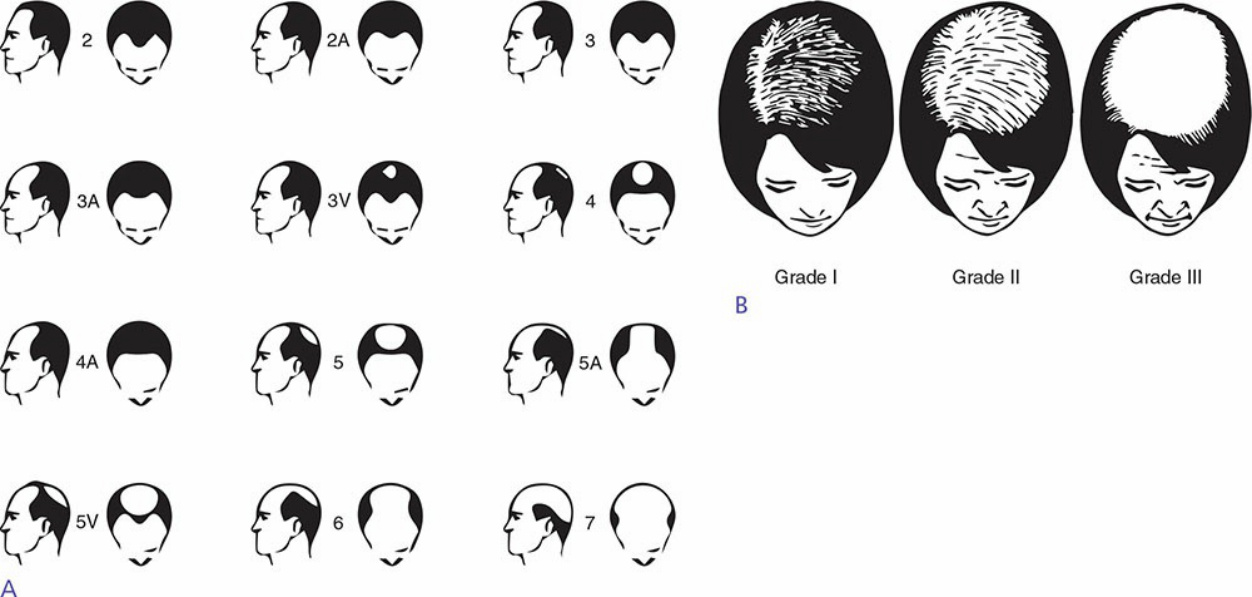
Figure 62-1. (A) Norwood classification of male pattern baldness. (B) Ludwig classification of female pattern hair loss.