SURGICAL APPROACH
SURGICAL APPROACH
Full body shaping requires significant downtime and surgical planning. If numerous areas of the body are to be reduced in size and contoured, for safety reasons the procedures need to be staged. In some instances, surgical cutting/skin removal and/or permanent implants are needed to for the best outcome, and recovery time is needed between procedures.
In both males and females, the procedures are staged to keep each procedure less than 5 L in fat removal. These procedures are generally performed under general anesthesia. Local tumescent approaches make it almost impossible to obtain an adequate amount of fat removed and body contours created without significant pain. Moreover, limitations in the amount of anesthetic require patients to undergo general anesthesia with a variation in the traditional tumescent fluid to limit toxicity (Table 60-1).12
Typical staging of a female full body contouring procedure
Procedure 1: Calf/ankle and forearm Procedure 2: Circumferential torso, upper arm, buttock (at least 3 days after first procedure) Procedure 3: Circumferential thigh (at least 7 days after second procedure)
In any of these procedures, neck and face liposuction, fat transfer, cellulite release (e.g., Cellfina), and/or skin tightening (e.g., ThermiRF) can be added. Implants and skin removal surgery are best performed during the last procedure if possible for the purposes of easier healing and simpler postoperative recovery. However, the procedures are tailored to the individual patient. Those with lipedema (larger amounts of disproportion) may require a fourth surgery that addresses sections of the buttock or thigh that could not be addressed in the previous procedures. In some patients, the full upper body (torso and arms), calves and full medial thighs, and knees can be addressed in one longer procedure without increased risk and fitting within the guidelines of acceptable safe amounts of fat removal in a single procedure if they are more athletic and require more contouring and shaping than large volume fat removal. Fat transfer is typical in the breast, buttock, and thighs to give a more “S-curve” and projected buttock and hip. A typical expectation for improvement on the breast is 0.5 to 1.5 cup size, but to maintain fat viability in this area a series of future fat injection touch-up procedures may be needed. Facial augmentation with any additional fat can give great improvement in facial contour as well as fine wrinkles of the neck and chest.13
In the male athletic patient, the majority of all the work desired can be performed in a single procedure. The length of the procedure is extended if the patient requires skin removal surgery/body lifting (e.g., abdominoplasty, nipple lift) (Fig. 60-20). If the patient is larger and has significant “debulking” fat removal that is necessary, this should be done in a process as shown above in the female, and 3 to 6 months should be waited until a high definition contouring procedure (etching, sculpting, fat transfer) is
performed.
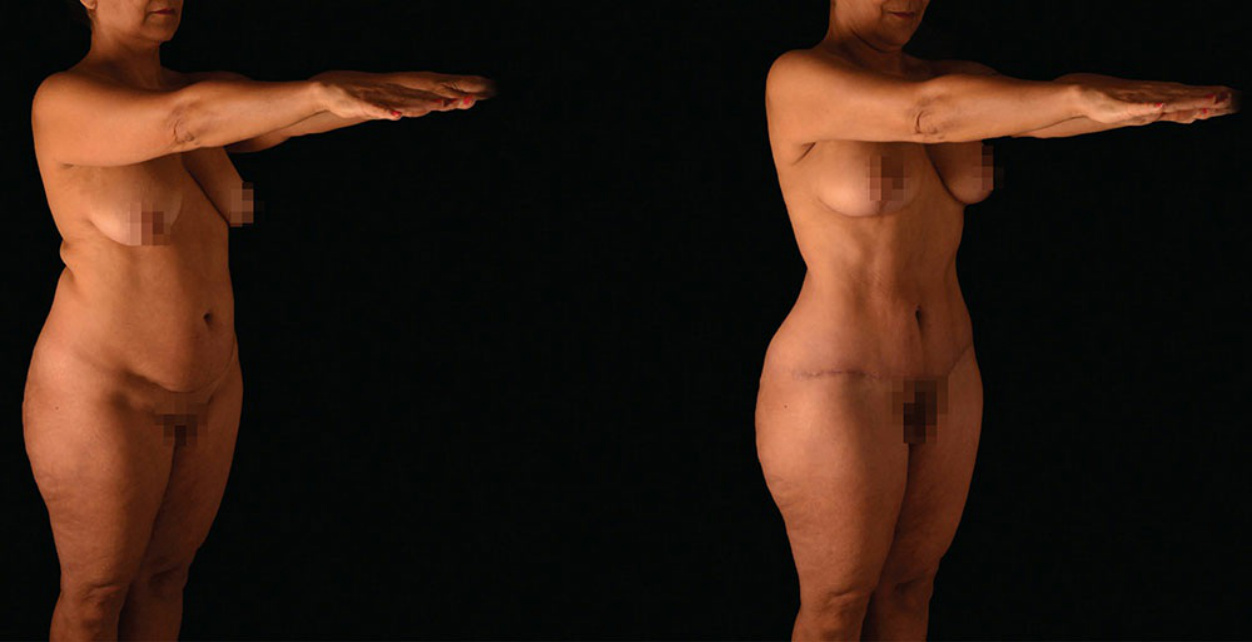
Figure 60-20. Female high definition body contouring with abdominoplasty and breast lift. Before (left) and 3 months after (right) a high definition body transformation procedure. This patient had children and was left with loose skin of the abdomen and breast descent. A high definition body contouring liposculpting procedure of the circumferential torso, arms, and inner thighs was performed with fat grafting to the buttocks. Abdominoplasty was performed to tighten the lower abdominal skin in order for liposculpting to provide a more athletic contour. Breast lift was performed to improve the appearance and size of the breasts, completing the full body transformational procedure.
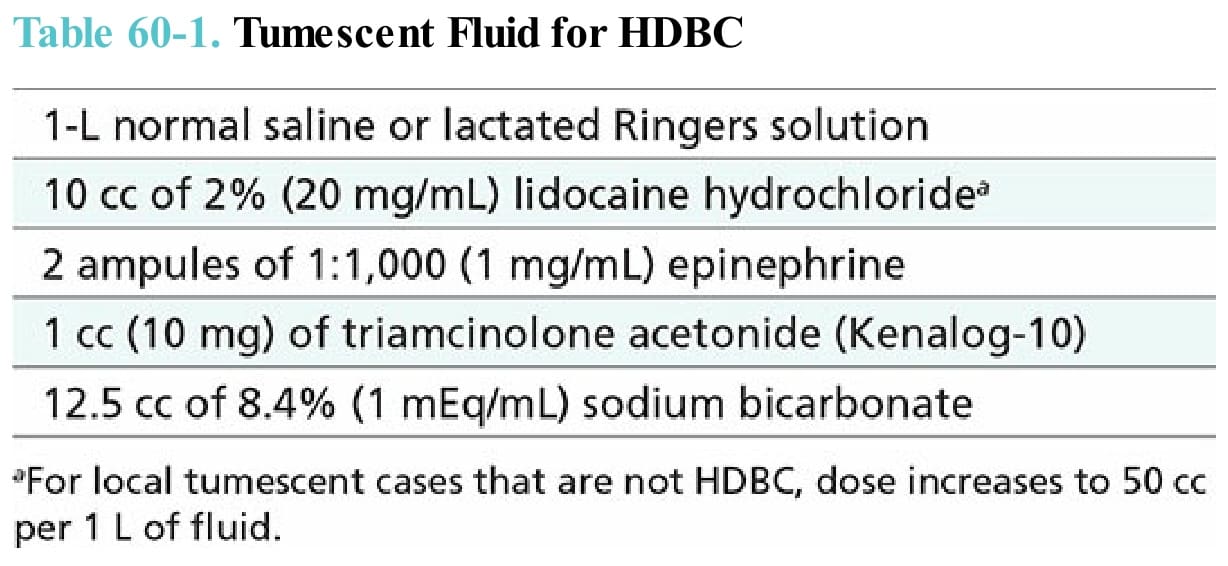
Table 60-1. Tumescent Fluid for HDBC