HDBC KEY STEPS
HDBC KEY STEPS
In order to perform liposuction there are key steps that are necessary in order to obtain symmetrical bulk improvement and a degree of contouring. As described above, the superficial layer is then treated after debulking of the deeper layers in order to produce contouring, definition, and etch lines.
Step 1: Proper marking and placement of port/entrance sites
Previous traditional approaches to fat reduction involved marking a large problem area of fat for tumescence, and concentric circles more specifically identifying the area of most desired reduction (Fig. 60-6). This type of approach, although logical for standard fat reduction in a localized area, makes it extremely difficult to contour surrounding areas, and impossible to reshape the area, as the underlying anatomy is not taken into consideration (muscular lines and bony landmarks). Moreover, port or entrance sites were placed in areas around this circularly identified bulk fat in order to allow the surgeon to address the area in a crisscross pattern that was thought to decrease the chance of irregularities. With hand cannulas or even traditional PAL, the back-and-forth nature of extraction can leave “lines” if the fatty layers are not addressed evenly. In contrast, with rotary devices this is rarely the case, and only a single entrance site can be used, so scars are limited and a crisscrossing of entrance sites is not needed to get even results and include anatomical and muscular shadowing (Fig. 60-7).
For example, leg contouring with liposuction is very complex. More women (as opposed to men) have genetic problem areas of fat and cellulite in this area, and early skin laxity is often seen in the inner thighs, buttock roll, and above the knees. Treatment of this area requires markings that are strategically placed in order to remove fat circumferentially without indentations or worsening cellulite. Furthermore, women show off their legs much more than men and do not want to have multiple incision sites that will leave noticeable scars, a give-away that a surgical procedure was performed. Thus, port/entrance site placement has to be inconspicuous and able to reach all areas of the legs (Fig. 60-8A and B).
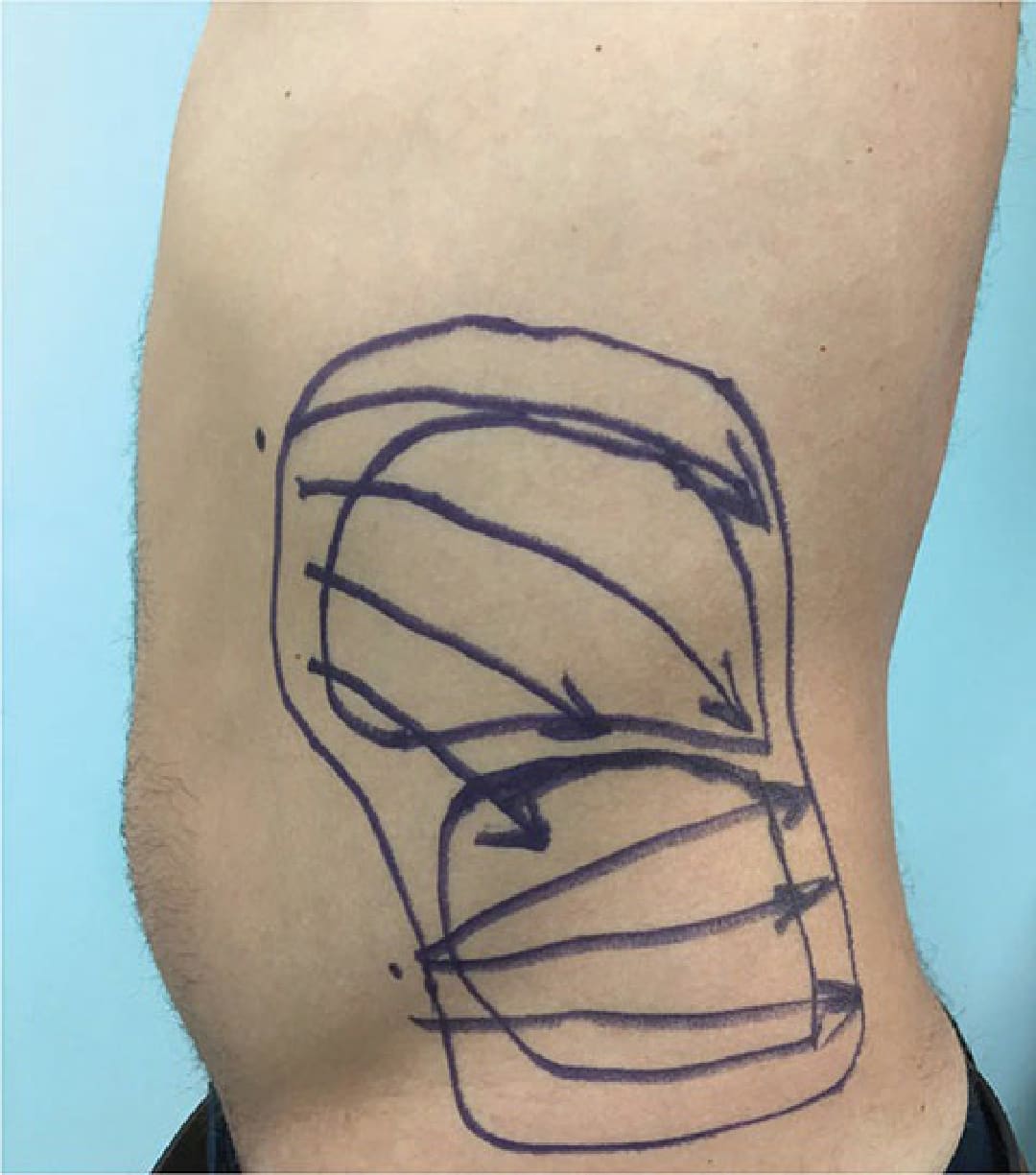
Figure 60-6. Traditional markings of the male abdomen. Concentric circles are used to identify the larger tumescent area with inner circles to identify peak problem areas for extraction. Note the placement of port/entrance sites traditionally used for a crisscross pattern of extraction.
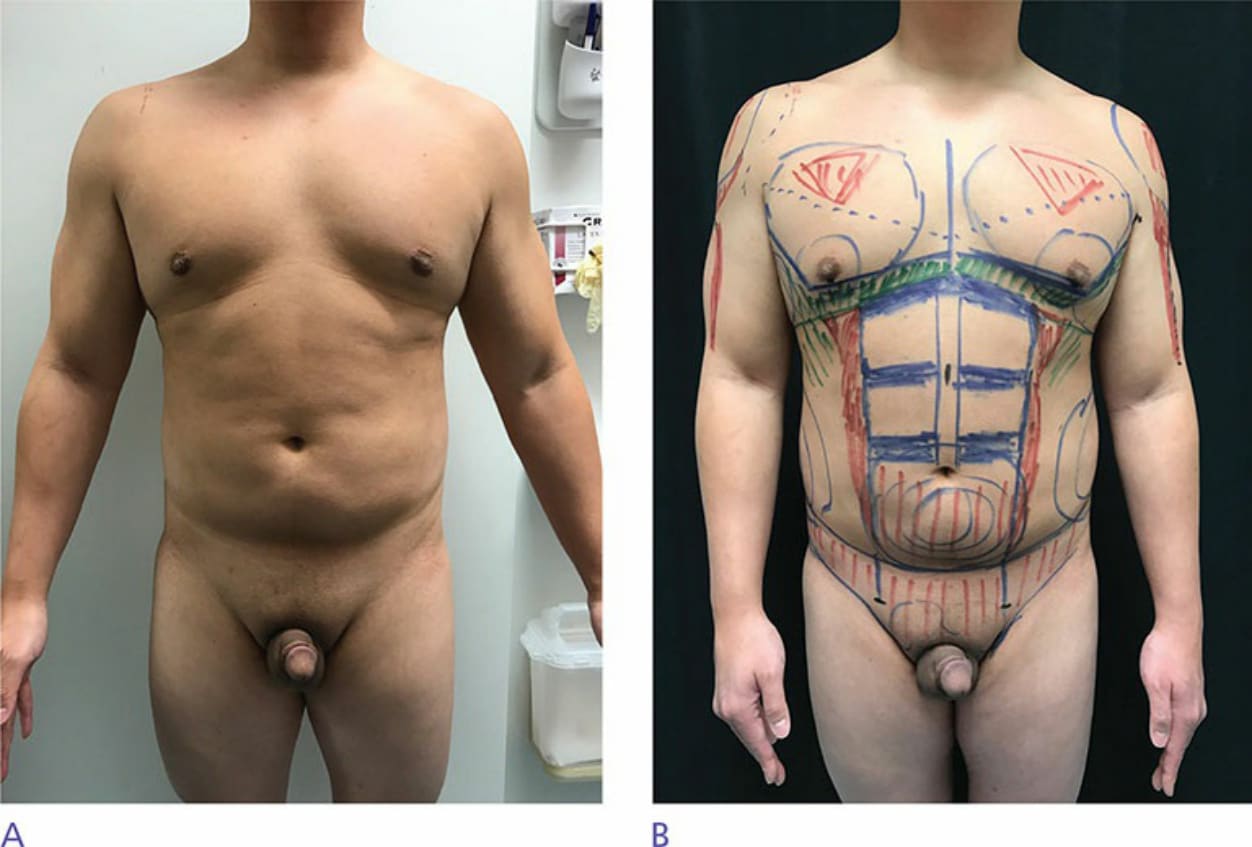
Figure 60-7. (A and B) Pre- and post-high definition body contouring markings of the male abdomen. Markings of both the deep (circular) and superficial (lines) fat layers based on bulk problem areas as well as anatomical and muscular landmarks are shown. Entrance sites are hidden and placed in areas where extraction can be high-yield; there is no need for a crisscross pattern of extraction when rotary devices are used. Note, areas of fat grafting are also identified by red triangles and circles in areas of planned muscular injection postharvesting.
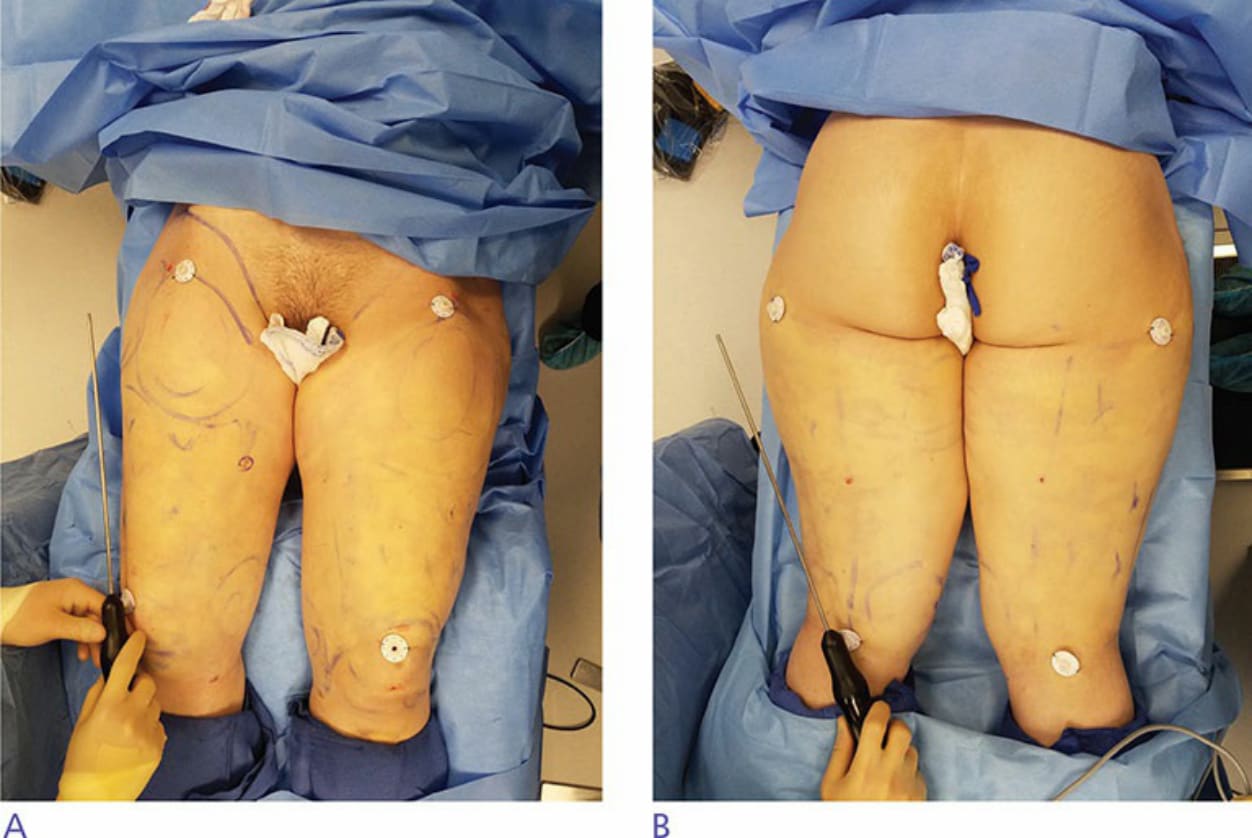
Figure 60-8. (A and B) High definition body contouring VASER port/entrance sites for leg contouring. Notice that only a few port sites can reach the full leg and address problem areas and cellulite in a 360-degree fashion circumferentially. Avoid placement in the midthigh, as this is a dead giveaway that a procedure was performed if scars are noticeable.