Poly-L-lactic acid
Poly-L-lactic acid
Sculptra, a synthetic polymer of poly-L-lactic acid, provides subtle but buildable rejuvenation that persists for up to 18 to 24 months by upregulating endogenous neocollagenesis. It typically requires multiple treatments to obtain desired results. Sold as a freeze-dried powder that can be stored at room temperature, Sculptra is essentially pulverized polyglactin 910 (Vicryl®) suture material, and must be reconstituted with sterile water or saline into a suspension for injection.
First developed and marketed in Europe as New-Fill®, Sculptra gained FDA approval for treatment of HIV-related facial lipoatrophy in 2004. In 2009, the FDA-
approved Sculptra Aesthetic for shallow-to-deep wrinkles, including the nasolabial folds, in immunocompetent patients. Panfacial injections are an off-label option in patients with limited volume loss. Sculptra is typically injected with 25- or 26-gauge needles serially or as depots into the subcutaneous plane. More superficial deposition increases the risk of visible nodules. After injection, immediate correction is the result of edema and solvent from the solution, which dissipates. Persistent augmentation takes longer to appear and requires three or more treatment sessions, spaced every 3 to 6 weeks.28
Preparation and storage practices vary among practitioners. Current packaging suggests reconstituting each vial with 4-mL sterile water and 1-mL lidocaine just 2 hours before use. However, the resultant 5 mL of solution is thick and can clog syringes or more readily form papulonodules, so most clinicians prepare their mixture with as much as 8 to 11 mL of sterile water at >24 hours.27 Agitating the vial and/or syringe also helps maintain particles in solution. Nonetheless, frequent needles changes or back aspiration may be needed if the product precipitates.
Though not unique to this filler, formation of delayed-onset papules, nodules, or granulomatous reactions at the site of injection are important adverse effects after Sculptra (Fig. 58-7). In the phase 3 extension study, these complications occurred in 17.8% (20/116 patients) of treated compared to 12.8% (15/117 patients) of control sites and appeared months later, often persisting for more than a year.29 Reconstituting the solution farther in advance, diluting with larger volumes, injecting into the subcutis rather than the dermis, administering smaller aliquots, and massaging treatment sites postprocedurally are strategies used to prevent papulonodule formation. In fact, massaging should continue at home in accordance with the “Rule of 5’s:” 5 minutes, 5 times per day for 5 days. No controlled studies to date have determined whether this technique truly limits the development of delayed reactions.
stained for hematoxylin and eosin (H&E) (B).
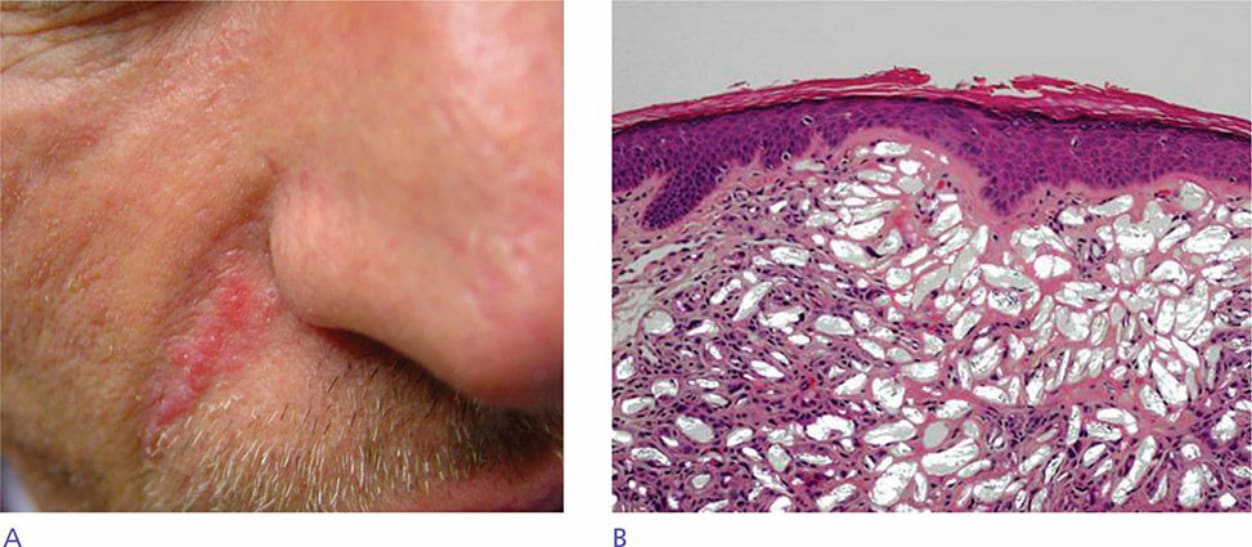
Figure 58-7. Granulomatous papules after intradermal Sculptra injection. Clinical image (A) and histopathology