ANESTHESIA
ANESTHESIA
Strict sterile technique is not required, and disinfection using chlorhexidine or alcohol is sufficient. Cryoanesthesia, for example, with liquid nitrogen or a refrigerating spray, is recommended as the inflamed area is difficult to anesthetize using injectable anesthetics. Cryoanesthesia should be performed over the full length of the planned incision or injection site. The application of cryoanesthesia should be quickly followed by the injection or incision, as this technique results only in brief anesthesia (Fig. 54-3A and B). Alternatively, local anesthesia of an abscess can be performed with lidocaine with epinephrine through a 30-gauge needle.19,20 Alkalinizing the lidocaine by adding sodium bicarbonate solution may reduce the burning sensation during the injection caused by the acidity of lidocaine.21 Additional injections in a local field block pattern may be necessary for the patient’s comfort.20 Nonetheless, the procedure often remains painful, as the area is extremely difficult to anesthetize due to diffuse inflammation. Prior application of a eutectic mixture of local anesthetics (EMLA) containing lidocaine and prilocaine, for 30 minutes to 1 hour before the procedure may be used to reduce the pain of local injections or the incision and drainage procedure.
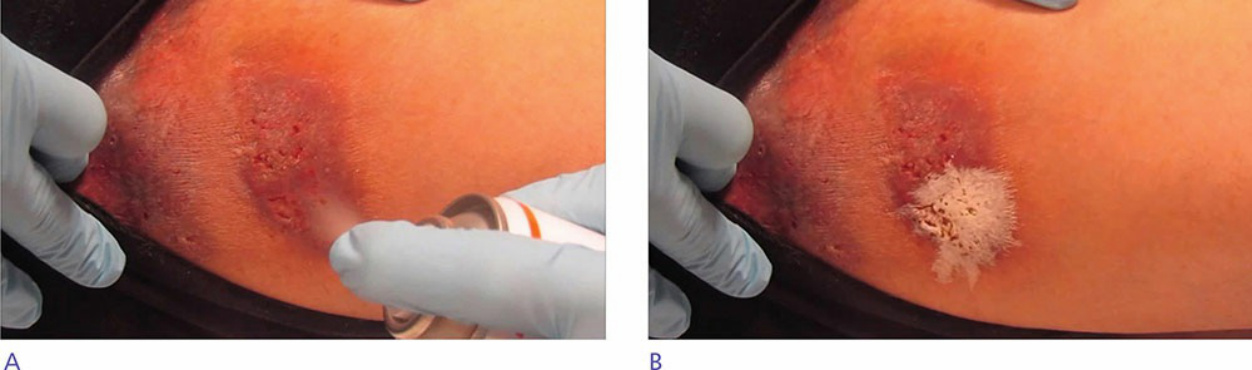
Figure 54-3. (A) Application of cryoanaesthesia to the medial left thigh before intralesional triamcinolone injection. (B) White coloring of the skin after application of cryoanesthesia.