BLCC
BLCC
BLCC is a living, bilayered cellular construct. Its epidermal equivalent is composed of a stratified layer of human neonatal keratinocytes, while the underlying dermal layer is comprised of bovine type I collagen and human neonatal fibroblasts (Fig. 53-3).78,92
Indications BLCC is indicated, in conjunction with standard of care therapy, for the treatment of noninfected, partial- and full-thickness VLUs of greater than 1 month duration, and fullthickness DFUs of greater than 3 weeks duration without exposed tendon, muscle,
capsule, or bone, which have not adequately responded to standard therapy alone.93 In a randomized controlled trial for VLUs, BLCC healed over 63% of patients at 6 months compared to 49% of patients receiving standard compression therapy. However, BLCC had even greater benefits in long-standing VLUs of greater than 1 year duration, reaching 47% wound closure at 24 weeks compared to 19% in controls.81 In a randomized controlled trial for DFUs, 56% of patients achieved wound closure by 12 weeks compared to 38% of patients receiving only offloading and debridement.82 BLCC has, however, also been utilized in the treatment of burns, surgical wounds, radiation ulcers, and conditions such as epidermolysis bullosa and pyoderma gangrenosum.78,94
Contraindications Contraindications include infection, known allergy to bovine collagen, and known hypersensitivity to components of the agarose shipping medium.93
Procedural technique BLCC is supplied in a circular disc. The product should be stored at 20° to 23°C in its air-sealed bag containing 10% CO2/air mixture and nutrient medium. The matrix should be handled using an aseptic technique. Upon uncovering the disc, gauze may be placed over the matrix and moistened with a few drops of normal saline to aid in removal of the matrix from the medium. Surgical forceps allow for ease of removal of the matrix onto the moistened gauze while leaving it intact and separating it from the medium. The matrix may then be perforated using a scalpel before application to allow for drainage. The graft can be cut using scissors while on the gauze to better conform to the wound shape and to trim excessive product. The matrix can then be placed over a clean and properly debrided wound base. Placing the gauze over the wound with the graft down will allow the matrix to remain in the proper orientation, with the dermal layer facing down. The gauze can then be removed and the matrix can be evenly spread over the wound bed; any bending and folding should be corrected using a cotton tip applicator. Secure the product in place using adhesive strips and then cover it with a nonadherent dressing, followed by the appropriate secondary dressing.78,92,93
Complications and limitations Various adverse events have been reported, including suspected wound infection, cellulitis, exudate, and pain. Heavy exudate may cause the matrix to lift off the wound bed, reducing its effectiveness.93
Follow-up care Patients should be followed at least once per week for visualization of the matrix, though the secondary dressing may be changed as needed. Adherent pieces of the matrix should be left in place, while nonadherent remnants may be removed. Reapplication
may be necessary; data have supported the safety and efficacy of up to five applications. Patients should be counseled to continue compression therapy in the case of VLUs, and pressure-offloading in the case of DFUs, as BLCC does not address the underlying pathophysiology of these entities.93
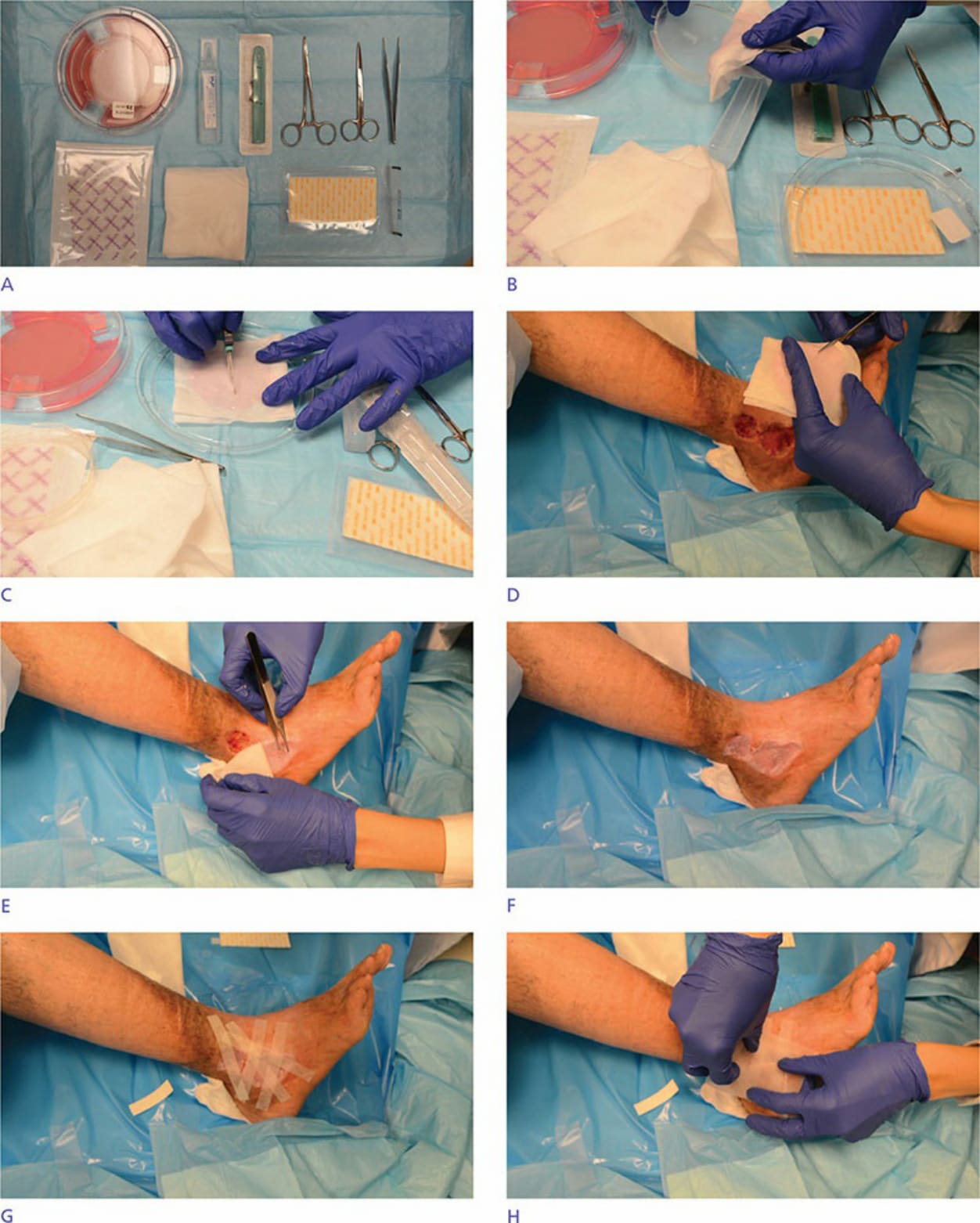
Figure 53-3. Bilayered skin construct placement step-by-step. (A) The surgical tray with the bilayered skin substitute is arranged. (B) The skin substitute is placed on a piece of gauze. (C) The skin substitute is gently scored and then (D) trimmed to fit the wound while on the gauze. (E) It is then applied to the wound. (F) Appearance after the wound has been covered with the skin substitute. (G) The skin substitute is gently taped in position and then (H) secured with an absorbent dressing.