Noncultured epidermal cell suspensions
Noncultured epidermal cell suspensions
The NCES technique for the treatment of vitiligo was first developed by Gauthier and Surleve-Bazeille,44 refined by Olsson and Juhlin,45,46 and further modified by Mulekar.47 The NCES technique has the distinct advantage of utilizing a DS to RS ratio of approximately 1:10, allowing for the treatment of larger areas.
Using this method, an ultra-thin skin graft is harvested from the DS, rinsed with NS, and immersed in a Petri dish containing trypsin. The trypsin must be removed from the refrigerator, brought to room temperature, and incubated at 37°C for 45 minutes before the graft is incubated. The sample is then incubated at 37°C with the epidermis facing upward for approximately 20 to 30 minutes, depending on graft thickness. After the graft is removed from the incubator, the trypsin is discarded and the graft rinsed with lactated Ringers (LR) six times. Next, the epidermis is manually separated from the dermis using forceps. The epidermis is subsequently broken down into small pieces using forceps, and the dermis is discarded. The epidermal fragments are rinsed with LR and transferred to a tube for centrifugation for 5 minutes at 2,000 rpm. However, this is dependent on the make and model of the centrifuge used. Once the cell pellet containing melanocytes and keratinocytes forms, any large tissue fragments are removed, and the pellet is resuspended in LR and transferred to a 1-mL syringe. The suspension should have a cloudy appearance, and may appear pigmented depending on the patient’s skin type (Fig. 52-5).
Once the RS is denuded to the level of the DEJ using either dermabrasion or laser, the cellular suspension may be applied to the RS through the hub of the syringe. Dressings are removed 4 to 7 days later, depending on RS location (4 days for the head, neck, and genitals and 7 days for the trunk and extremities).16 Repigmentation is usually observed between 2 weeks and 2 months postoperatively, with maximum repigmentation gained by 6 to 18 months. Color match typically improves with time13 (Fig. 52-6).
A study comparing NCES with SBEG in 41 patients with stable focal, segmental, and generalized vitiligo types found that more NCES-treated lesions had excellent
repigmentation, but both groups showed excellent color match. Repigmentation was observed slightly earlier in the SBEG group, which may be attributed to the higher melanocyte density in SBEG.31 However, the overall lesser repigmentation in SBEG may be due to a reduced number of viable melanocytes in the epidermis secondary to longer suctioning times, as reported by Czajkowski et al.48 A greater degree of repigmentation in NCES may also be attributed to the maintenance of keratinocytes during NCES grafting, since they greatly contribute to the growth and development of melanocytes at the RS. In contrast, keratinocytes are lost with the shedding of the epidermal graft 1 to 2 weeks following SBEG after melanocytes release to the RS.31
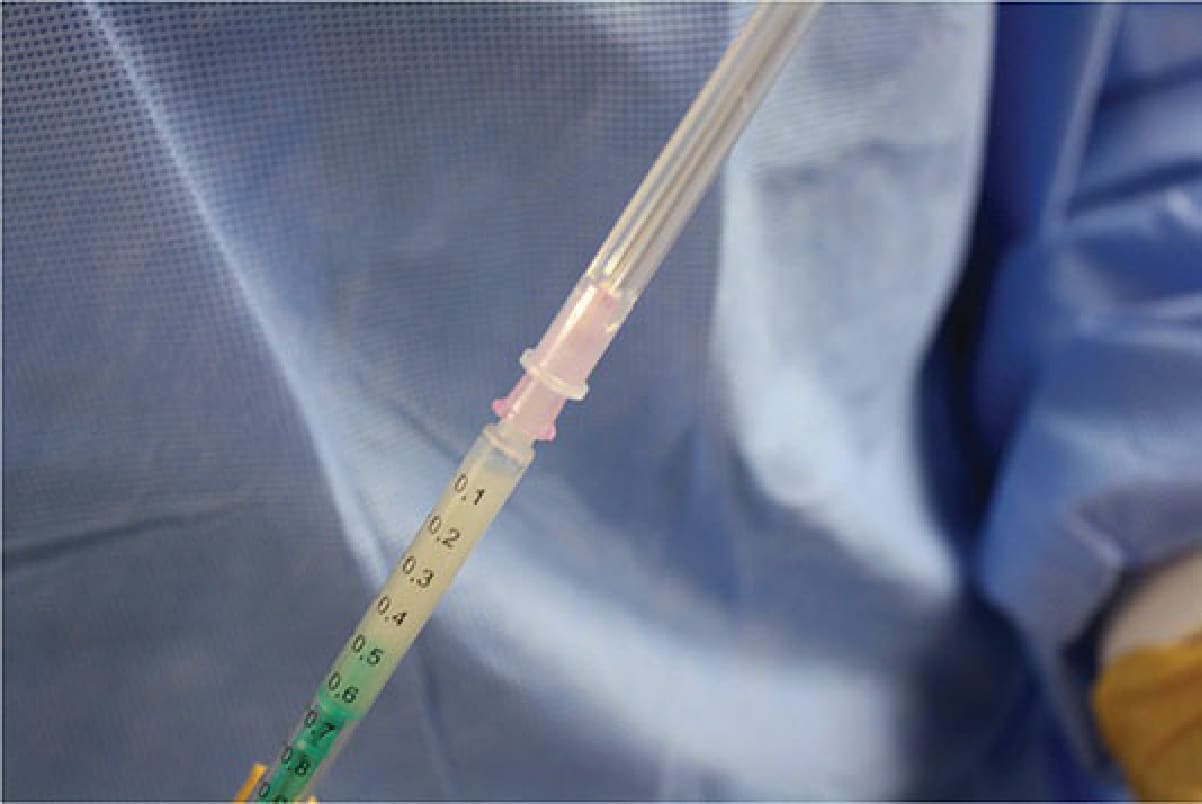
Figure 52-5. Cell suspension for noncultured epidermal cell suspension graft. Note cloudy appearance, which can have a brownish color in more pigmented individuals.
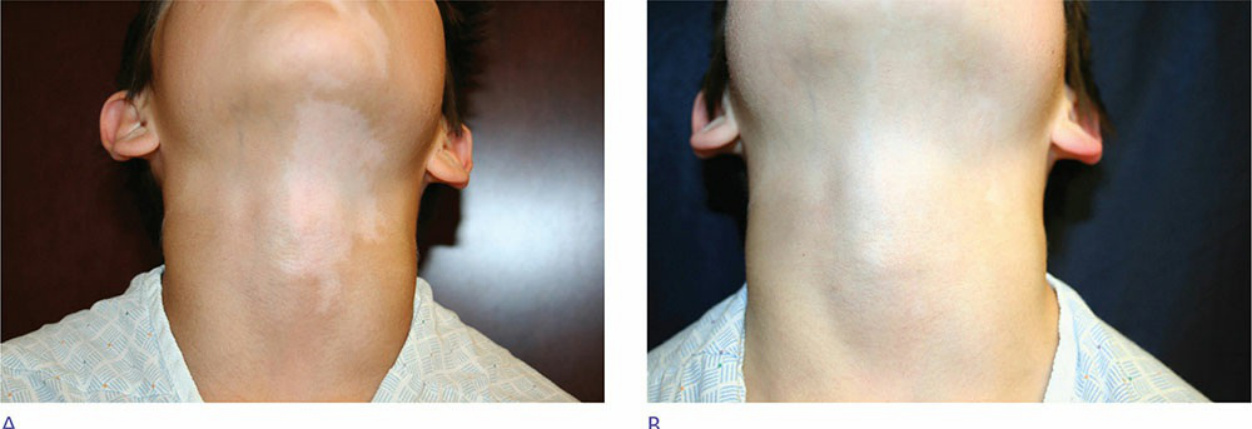
Figure 52-6. (A) Anterior neck at baseline. (B) Anterior neck 7 months after treatment with NCES graft. Greater than 95% repigmentation achieved with excellent color match.