Surgical technique for pilar cysts (scalp)
Surgical technique for pilar cysts (scalp)
Slit excision is a technique commonly used to remove these types of cysts on the scalp. Many patients avoid removing these because they fear that the surrounding area will be shaved. In general, shaving or clipping the hair is unnecessary beyond the small area overlying the portion of the scalp that may be excised completely. This is enormously appreciated by patients, and serves to make removal a very quick procedure that is gratifying for both the patient and surgeon.
The area is first cleaned with chlorhexidine, pushing the hair in all directions away from the cyst. When dried, this assists in keeping the hair back away from the site of cyst removal. Additionally, ointment can be applied to the surrounding area, further helping to keep back the hair. Sterile hair clips and/or cloth tape may also be used in preventing hair from interfering with the procedure. Keeping hair from interfering with the procedure will not only make it easier, but hair that is drawn into the wound at the time of closure can become a nidus for infection or later cyst formation, and should be avoided. The surgical incision is started superficially, with the goal of visualizing the cyst without puncturing the wall. Once the wall is visualized, and after careful undermining laterally, gently applied lateral pressure alone often permits the cyst to easily emerge fully intact. This is the ideal scenario, as it ensures that the entire cyst has been removed and there will be little chance of recurrence. This approach results in no
tension on the wound edges, though buried sutures may be helpful for dead space minimization.
Pilar cysts enlarge over time, leading to redundant skin development, particularly overlying larger cysts. This redundant tissue will often need to be removed at the time of closure. Large pilar cysts may include distorted hair shafts, decreased hair growth, or even complete alopecia over the central portion of the cyst, and this alopecic skin may be trimmed and removed at the time of closure. Percutaneous suturing approaches (see Chapter 13) may be helpful to reduce dead space when working in narrow scalp wounds.
Due to the vascularity of the scalp, postoperative bleeding is a risk, and careful intraoperative hemostasis coupled with dead space minimization and a pressure dressing application are helpful. Pressure dressings should ideally remain in place for 24 hours, and can be secured with a tie-over pony-tail utilizing the patient’s own surrounding hair (Fig. 50-10).
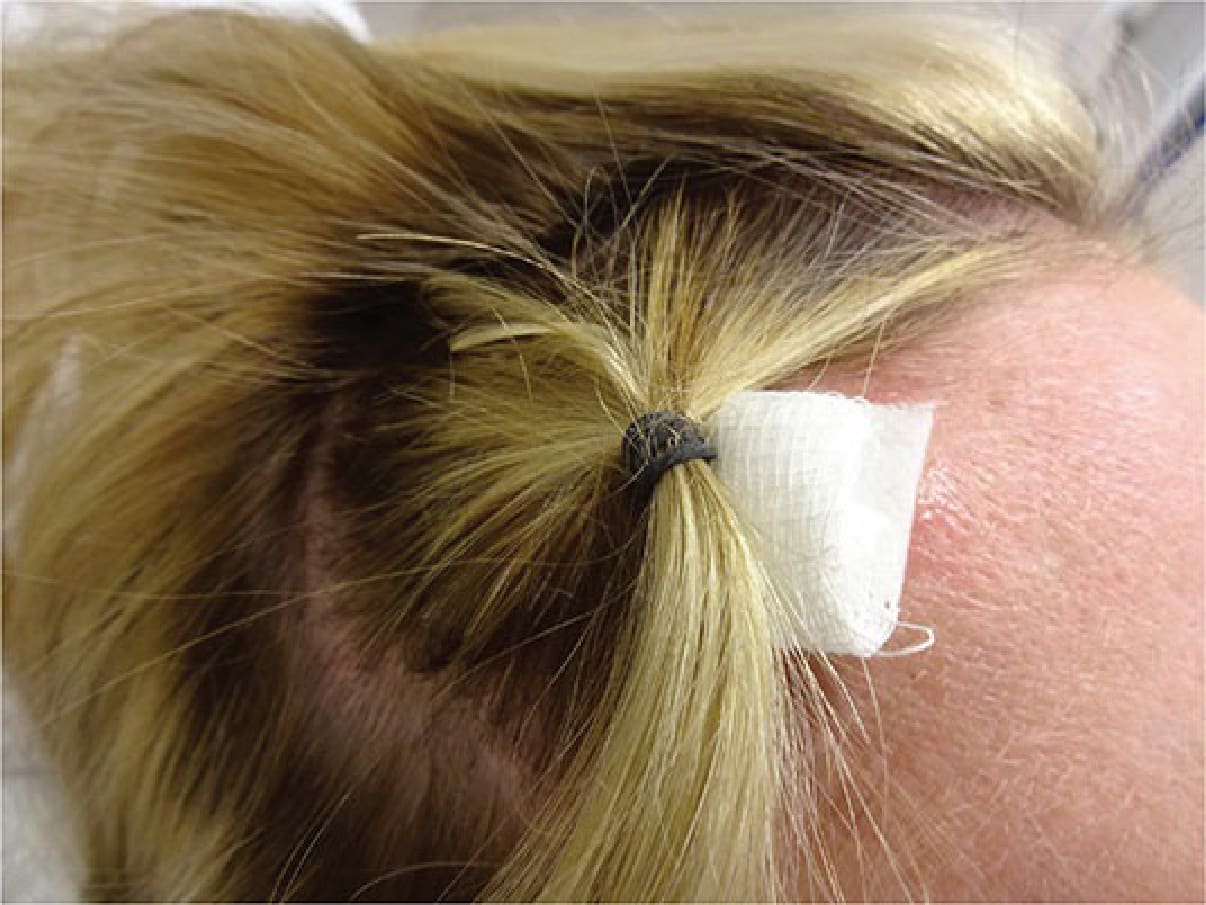
Figure 50-10. Pressure dressings should ideally remain in place for 24 hours, and can be secured with a tie-over pony-tail utilizing the patient’s own surrounding hair.