Aesthetic Considerations
Aesthetic Considerations
As noted above, many patients do not have high aesthetic expectations regarding their scalp appearance, though this is quite variable and should always be discussed during the preoperative consultation. On the scalp, dog-ears often resolve spontaneously.11–13 Conversely, concavities may not resolve, and although they may not be highly noticeable, they should be avoided when possible. This is one of the benefits of tertiary closure, as granulation tissue may help provide bulk to a planned graft site.
Reconstructing hairlines, when they exist, is perhaps the most important aesthetic consideration in reconstruction of the scalp. Therefore, when it is possible to reestablish the hairline, more aggressive consideration of flap closure should be made (Fig. 44-20). Rotation flaps incised along the frontal hairline may reestablish the continuity of the hairline, and is an excellent strategy to be considered even if a very large flap is required. Typically, this flap results in favorably oriented hair follicles and a natural looking hairline.
CONCLUSIONS
Reconstruction of the scalp involves several unique considerations, as the lack of tissue elasticity in this location can make reconstruction of even modestly sized defects challenging. While dermatologic surgeons frequently eschew the use of grafts in lieu of local flaps, the scalp is an important exception to this general rule. Similarly, healing by secondary and tertiary intention, while always options in dermatologic surgery, are more often utilized on scalp defects. Still, linear closure, when feasible, remains the first-line approach, when possible, for scalp defects.
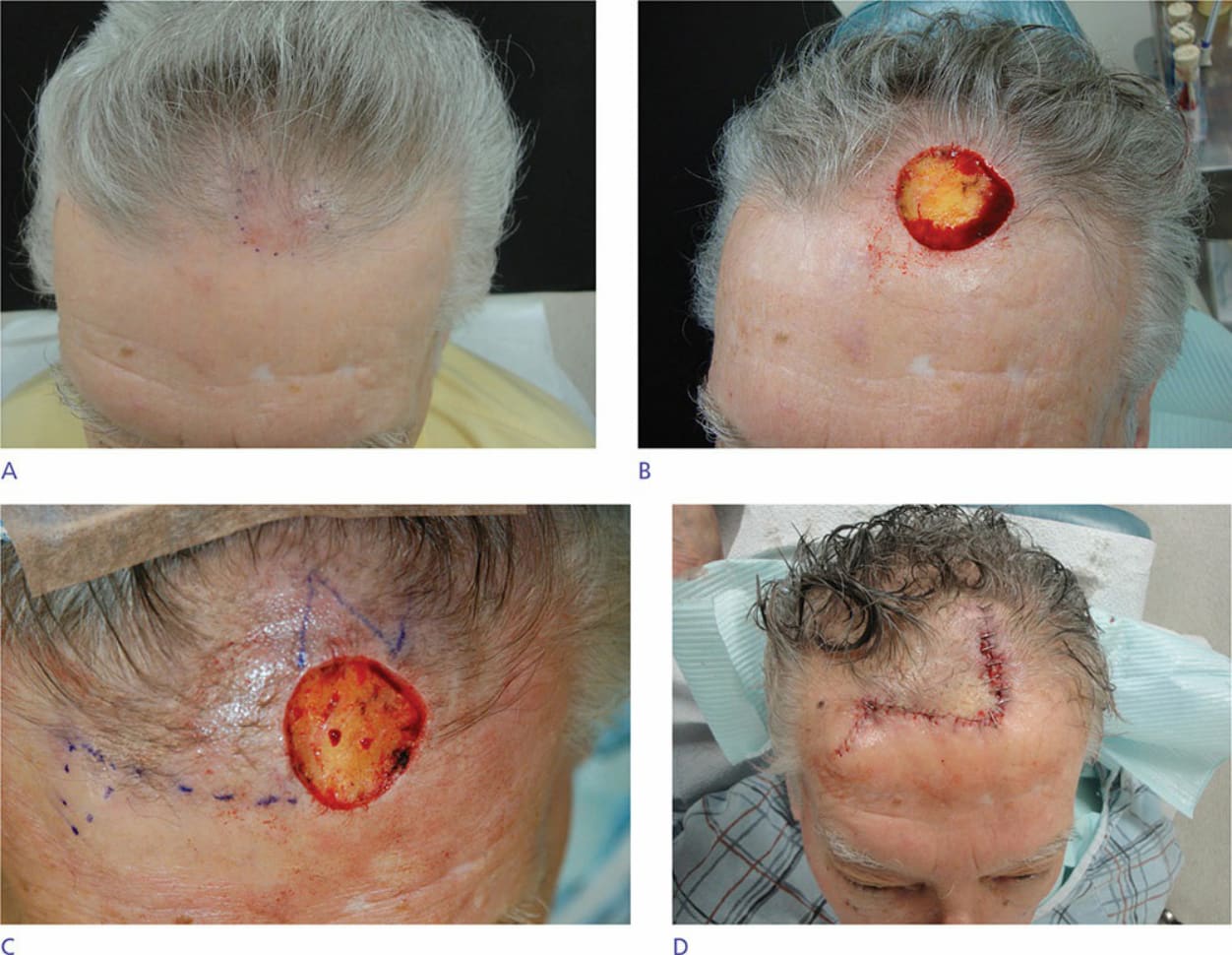
Figure 44-20. (A) Basal cell carcinoma on the frontal scalp. (B) Post Mohs defect. (C) Rotation flap planned for preservation of the frontal hairline. (D) Following execution of rotation flap.