Combination reconstructions
Combination reconstructions
Flap reconstructions for cheek defects borrow tissue from reservoirs that are based inferiorly and/or laterally, potentially producing heavy flaps that are restricted in motion and may pull on the lower eyelid. These factors increase the risk of ectropion from yielding eyelid skin or limit adequate closure of the defect. Attempts to mobilize skin too ambitiously can also result in distal edge necrosis or displace beard hair to sites without hair. Correct flap design, generous tissue release of cheek ligaments, and tacking sutures can help mitigate these concerns in many instances. However, large defects (>3 cm in diameter) and those approaching the lower eyelid frequently benefit from repair with two adjoining flaps or a flap and a graft, rather than a single reconstructive modality.
Multiple flaps When combining modalities of repair, two or more flaps may be preferred to closure with a flap and graft. The enhanced vascularity and improved color match to the recipient area are more likely to result in improved cosmesis. Combining flaps is most commonly employed when a defect spans two cosmetic units such as the cheek and nose or cheek and eyelid (Fig. 42-28). This combination allows placement of scars at the intervening cosmetic junction such as the nasofacial sulcus, where a shadow is typically expected.
Combined flaps harvest skin from two or more reservoirs and deliver skin to fill a defect that would not be sufficiently covered by a single flap. Cervicofacial rotationadvancement flaps may be a workhorse for large cheek defects, but skin immobility and pivotal restraint limit this flap’s movement in younger patients and those without a generous tissue reservoir. In such instances, an inferiorly based V-Y advancement flap may be used to bridge the distance that cannot be closed by the laterally based cervicofacial flap. Skin from the cervicofacial flap’s redundant cone is converted to a V-Y flap rather than discarded. Other combined modalities such as adjoining rhombic flaps and double V-Y flaps assist with splitting the distance of large cheek defects.
Flaps with grafts Zone 1 cheek defects that span eyelid skin are at greatest risk for cicatricial ectropion. The thin skin in this location is loosely draped from the eyelid margin and is susceptible to downward tension vectors, particularly from heavy flaps. Postoperative eyelid descent for large zone 1 defects can be mitigated by combining a flap with a graft. Skin graft interposition between the lid margin and an underlying flap such as a V-Y advancement minimizes the weight and pull on the eyelid (Fig. 42-29). In effect, the fullthickness skin graft acts as a spacer to protect and buttress the lid. Use of flaps with skin grafts may be used for zone 2 and 3 defects but this is typically reserved for instances where alternative reconstructive methods are not possible. The lack of an intrinsic blood supply and use of skin from a distant site during reconstruction with grafts reduces the reproducibility of outcomes and may result in inferior aesthetic outcomes.
CONCLUSIONS
Key principles of anatomy guide assessment of cheek defects and reconstructive planning. Linear closures, with their consistently reproducible results, minimal morbidity, and ease of execution are generally preferred, though large cheek defects may benefit from flap closure as well. Special attention to the free margins bordering the cheek, such as the lip and eyelid, are of particular importance given their functional and aesthetic value.
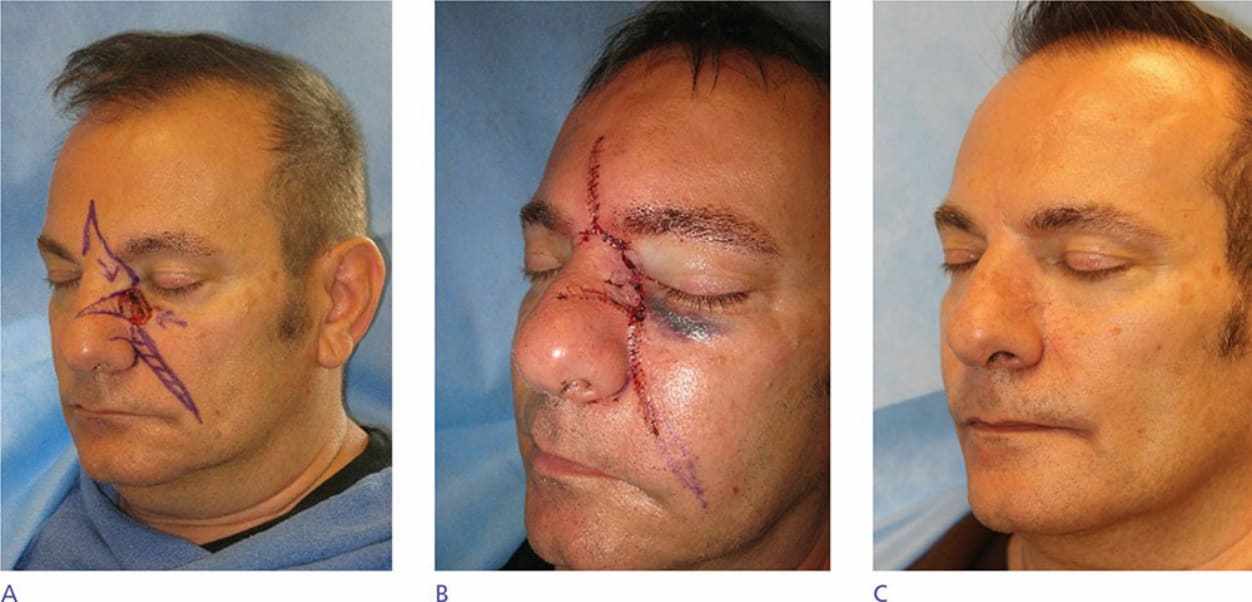
Figure 42-28. (A) Combined rotation and advancement flaps are designed for this medial cheek defect. Appearance immediately postoperatively (B) and at follow-up (C). Combining the flaps preserved the nasofacial sulcus and avoided a larger scar under the eye.
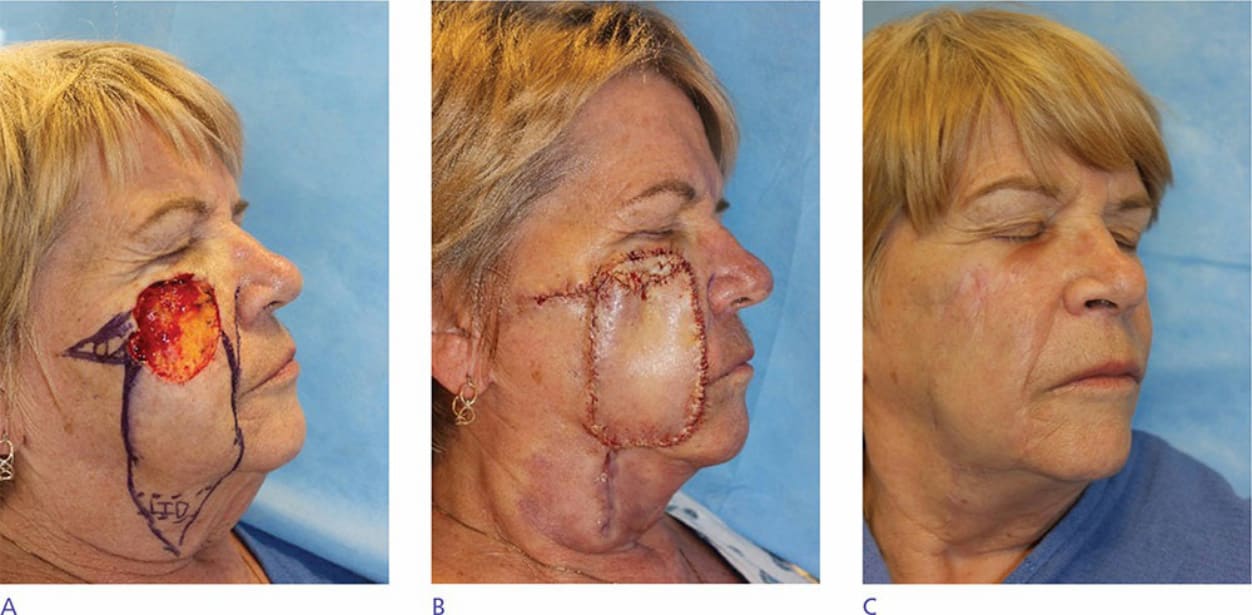
Figure 42-29. (A) A V-Y island pedicle advancement flap is planned for the cheek portion of the defect and a fullthickness skin graft is planned for the eyelid portion of the defect. The defect is too tall for coverage from the advancement flap. The full-thickness skin graft acts as a spacer to protect and buttress the lid. Appearance immediately postoperatively (B) and at follow-up (C).