Skin grafts
Skin grafts
Skin grafts are typically reserved for large, shallow wounds of the cheek. Smaller wounds can usually be repaired with a primary closure or local flap. Deeper wounds are best repaired with flaps that restore volume better than a skin graft.
Large wounds require harvesting grafts from generous tissue reservoirs, which rarely have a good color and texture match for cheek skin. Common reservoirs that allow direct closure of the donor site after harvesting large, full-thickness skin grafts include the periclavicular area, the lower abdomen, or the upper inner arm. Among these options, sun-damaged skin near the clavicle is most likely to resemble cheek skin. The lower abdomen and upper inner arm will almost always be pale compared to the relatively sun-damaged cheek. Split-thickness skin grafts are commonly harvested from the upper thigh or buttock, and they rarely have an ideal color and texture match (Fig. 42-15).
Burow’s grafts are one of the best options to obtain acceptable color and texture match for skin grafts of large cheek defects. A standing cone is excised from the inferior aspect of the cheek wound. Direct closure of the standing cone defect shrinks the size of the primary defect to a teardrop shape. A full-thickness skin graft from the standing cone excision is trimmed to match the size of the shrunken defect. The color and texture match are acceptable, since the donor site is immediately adjacent to the primary wounds (Fig. 42-16). For a full discussion of skin grafts, see Chapter 28.
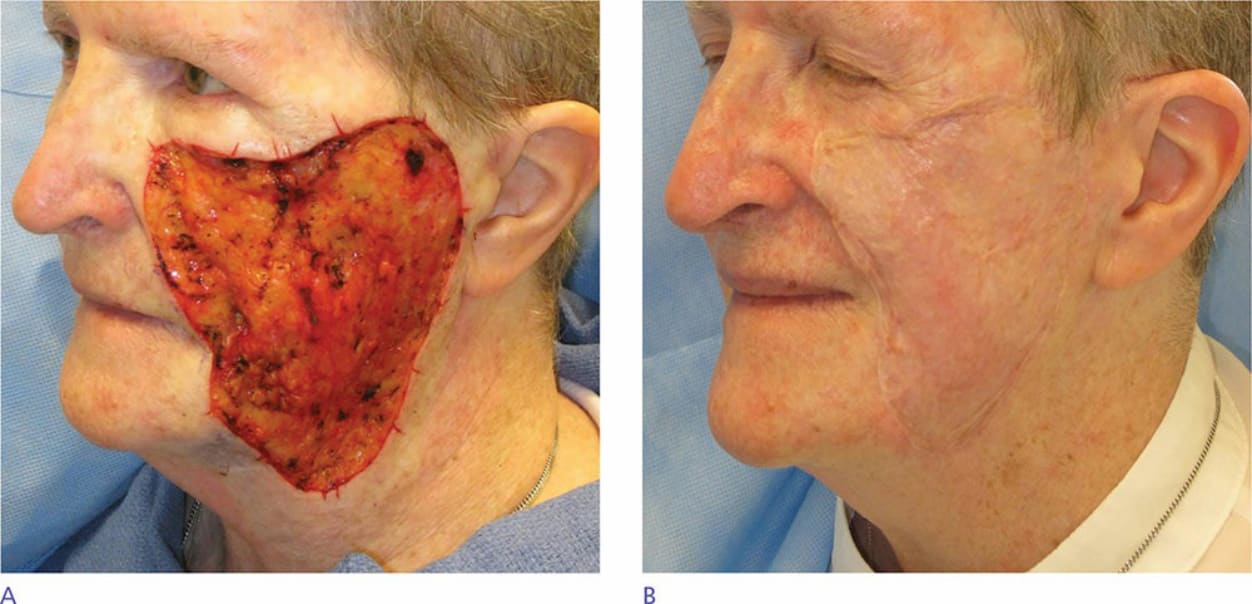
Figure 42-15. (A) A large defect involving nearly the entire cheek was repaired with a split-thickness skin graft. (B) The graft has healed with a relatively good color match. Scarring may be less conspicuous because the graft margins conform to the cosmetic subunit junction lines of the cheek.
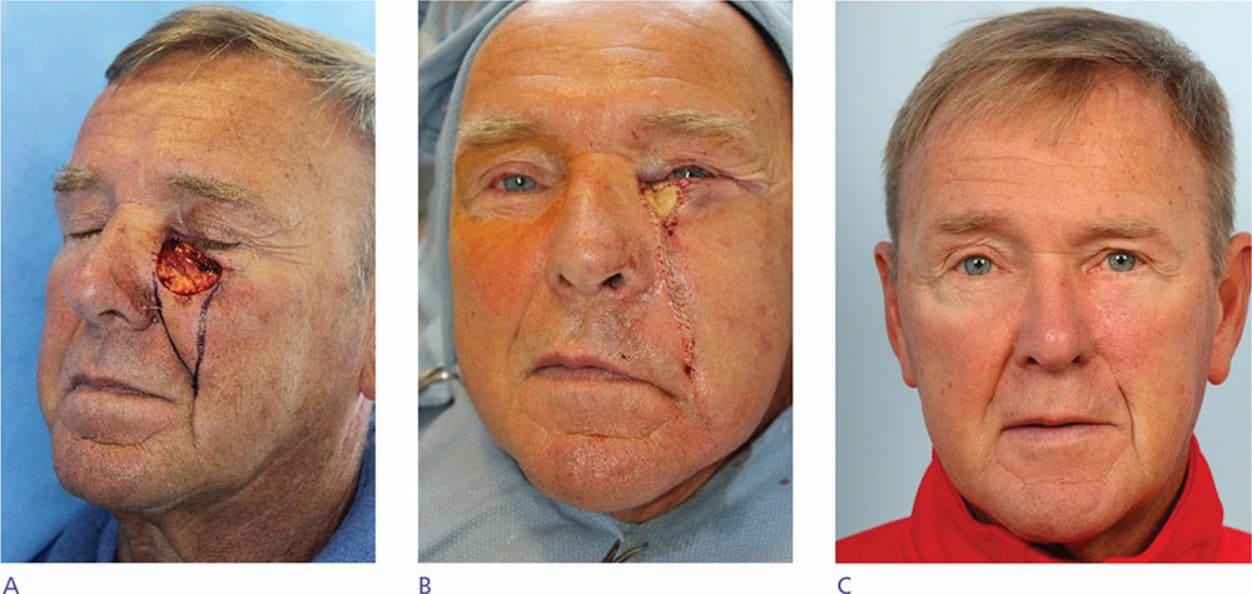
Figure 42-16. Burow’s grafts on the cheek often heal with better color and texture match. (A) A Burow’s graft is designed to repair this defect. (B) The skin from the inferior standing cone was used to cover the superior aspect of the wound. (C) The scar has healed with a relatively good color and texture match.