Second intention healing
Second intention healing
Second intention healing is uncommonly used to manage cheek wounds, because reconstruction with linear closures, flaps, or skin grafts is usually possible and provides a superior aesthetic and functional result. Scars from second intention healing predictably contract and heal with a shiny texture, which often contrasts sharply with the cheek skin, particularly in bearded areas. Scar contracture near free margins can distort the position of the lower eyelid and lips. Second intention healing on the cheek is most likely be employed in the preauricular region of zone 2, where the scar is not visible on frontal view and where scar contraction does not interrupt the contours of the midface or the position of adjacent free margins (Fig. 42-8).
Contracted scars from second intention healing usually form a long axis along the relaxed skin tension lines of the cheek. Patients should expect evolving color and volume of the scar. Scars that are initially pink and hypertrophic usually mature to a hypo- or hyperpigmented scars with flatter contour.
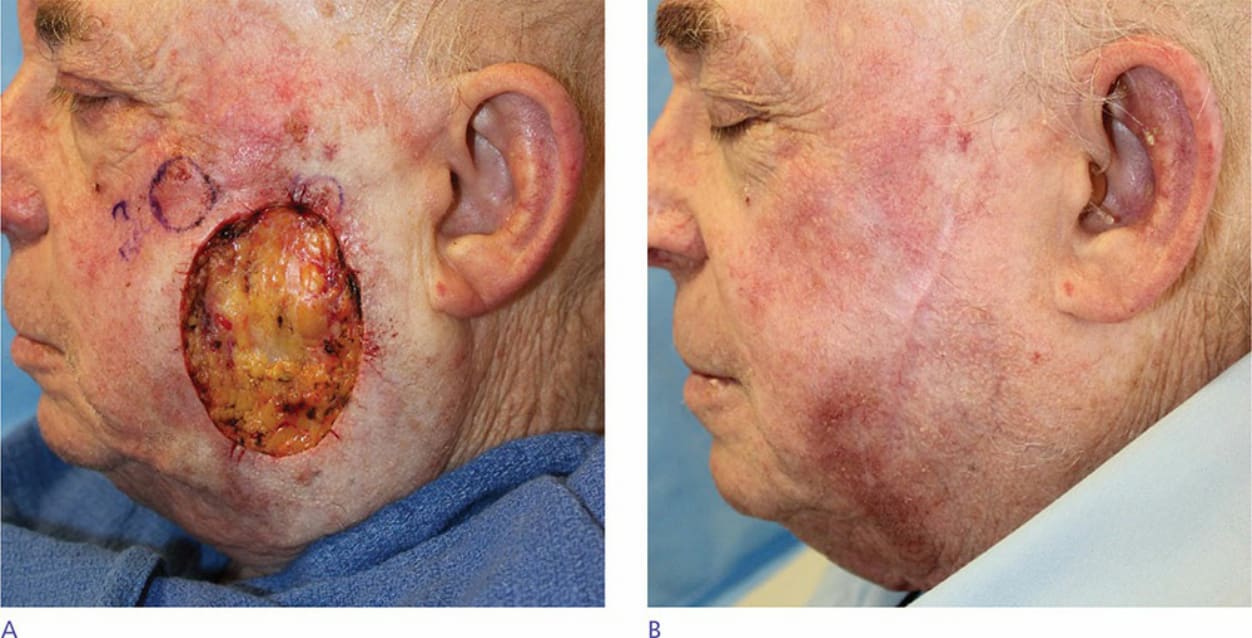
Figure 42-8. (A) The patient declined flap or graft reconstruction in favor of second intention healing. (B) The scar has predictably healed with a shiny texture and a ridge along the preferred line of tension. The wound was far enough from the central face that scar contraction did not alter free margin position.