Rotation
Rotation
Rotation flaps are niche repairs on the upper lip, but can prove exceptionally valuable in the appropriate situation (Fig. 40-34).10 Defects amenable to rotation are small to moderate wounds of the lateral subunit in the perialar region. Such wounds are often
repaired with island pedicle flaps (see below). If the wound is repaired linearly, the superior standing tissue cone removal compromises the apical triangle of the lip. The ideal candidate is a patient with a relatively high and broad upper lip and a prominent arciform nasolabial fold. The repair is designed by dropping a standing tissue cone from the wound to the vermillion border. The arc of rotation extends along the nasolabial fold. The flap is elevated above muscle and all the way to the vermillion border. In this rotation, tension is directed in large part along the primary tension vector, and the rotation is used to eliminate tissue redundancy. The rotated arc can generally be sewn out along the nasolabial fold without removal of a dog ear. It is important only to utilize this repair when the wound is relatively small in relation to the size of the lateral subunit. If there is too much rotational torque on the flap, the lateral vermillion can be elevated, thus resulting in a sneer appearance.
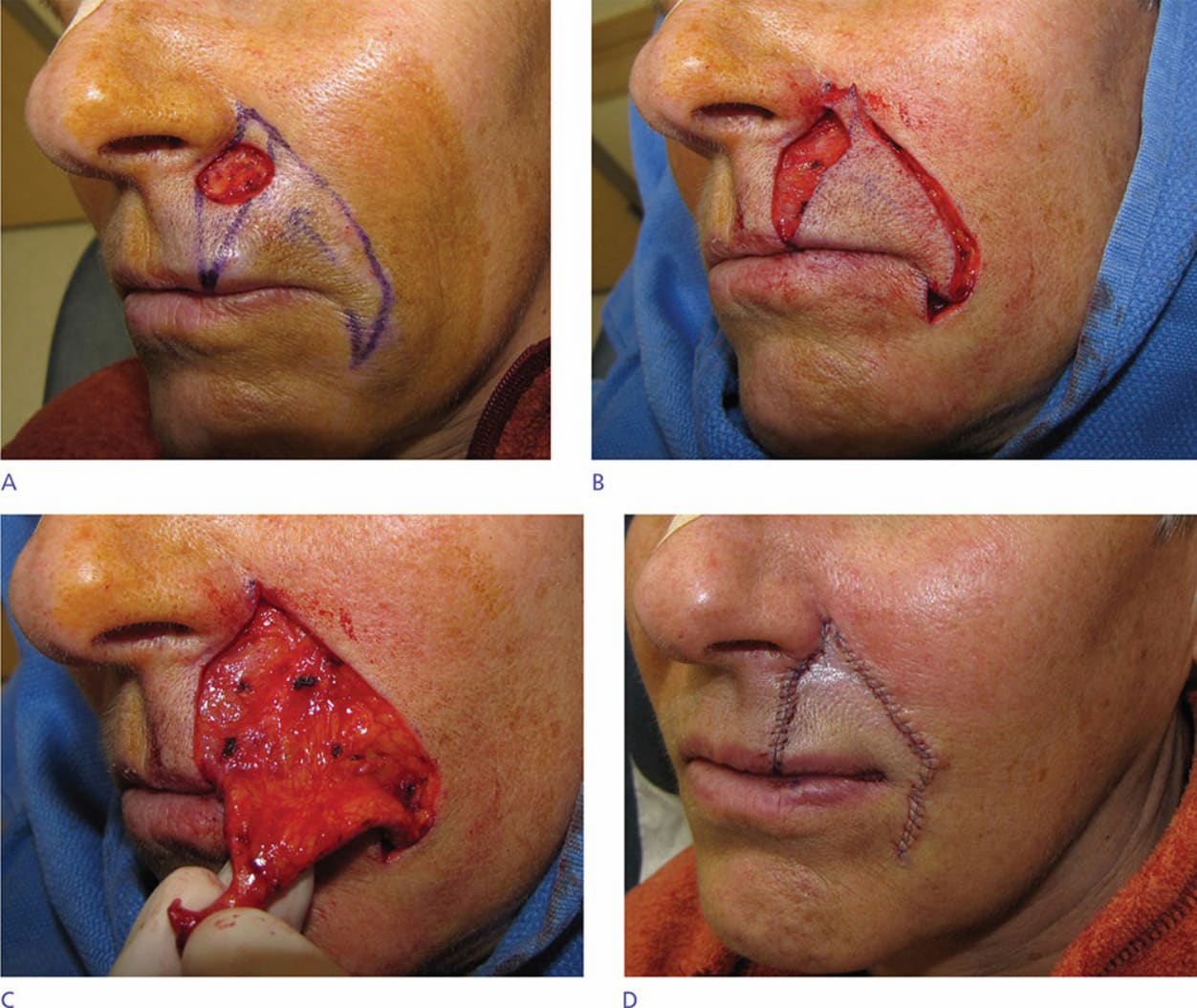
Figure 40-34. Rotation flap for a wound of the apical triangle region. (A) Operative wound and planned repair. The crescent of the repair extends down the nasolabial fold. (B) The flap is incised. (C) The flap is elevated above orbicularis. (D) Flap at suturing preserves the apical triangle and minimally resets the nasolabial fold. (Used with permission from Dr. Todd Holmes).