PRIMARY CLOSURE
PRIMARY CLOSURE
Primary closure is a side-to-side approximation of the edges of a wound. Tension lies along a single vector running perpendicular to the long axis of the wound, is greatest at the center, and decreases toward the apices. To minimize standing cones and to maintain normal contour, the ideal angles at the apices of a fusiform excision are <30 degrees, which requires a length:width ratio of 3:1 or greater. The tight, relatively immobile skin of the distal nose usually requires a length:width ratio of 4:1 or 5:1 (Fig. 39-8).9 Assuming proper design, the orientation, location, and tension of fusiform excisions on the nose are the main influences on an aesthetic outcome. The orientation of the fusiform excision determines the direction of the tension vectors. Horizontally oriented fusiform
excisions (e.g., in the alar groove) predictably pull up on the free margins, potentially resulting in an upward turn of the nasal tip or alar lift. To avoid malposition of the free margins, fusiform excisions on the nose are best oriented vertically or obliquely, so that tension vectors run parallel to the free margins and avoid an upward pull. Distortion is still possible, particularly on the ala, where elongation of the central axis after wound closure may result in downward push of the free margin.10
The tension of a fusiform excision may compress and distort the distal nose. If the center of the fusiform excision (i.e., the area of the highest tension) resides over the proximal and lateral nose, the underlying bones resist compression. However, compression is expected when the greatest tension lies over the nasal tip and ala. Tight closure of vertically oriented fusiform excisions over the distal midline nose (especially if tension is distal to the anterior septal angle) may flatten the nasal tip and cause flaring of the nostrils. Tight wounds on the distal paramedian nose and ala may compress the nostrils and compromise breathing.
The location of the primary closure may determine its effects on nasal symmetry, free margin position, and contour. Vertically oriented closures of the midline tip and dorsum usually cause symmetric changes to each side of the nose. By contrast, high-tension paramidline vertical closures may cause asymmetry from downward displacement of the ipsilateral alar margin and upward pull of the contralateral alar margin. Horizontally oriented fusiform excisions may not pull up on the tip or ala if they are small and located on the proximal dorsum or sidewall and nasal root. Primary closures that cross the concavities of the alar groove or the root of the nose may result in webbed scars that distort contour.
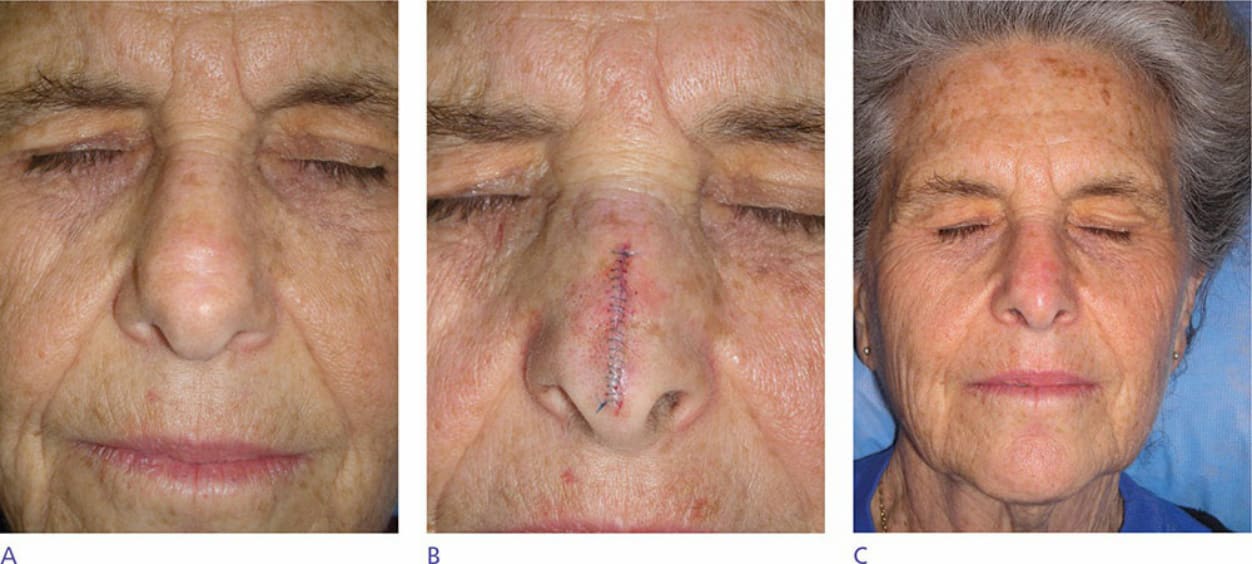
Figure 39-8. Primary closures on the nose often require a length:width ratio of >4:1 to avoid preserve contour. (A) Depressed scar of nasal tip with standing cones at each apex from insufficient length:width ratio. (B) The scar was excised and revised with a length:width ratio of >4:1. (C) Contour is restored and the scar is less conspicuous.