MODIFIED FROST SUTURE
MODIFIED FROST SUTURE
The Frost suture is a useful technique for opposing downward tension vectors and preserving or restoring the position of the lower eyelid (Fig. 38-21).18 A 4-0 monofilament suture is passed through the lower lid tarsal plate, entering and exiting the lid margin through the meibomian gland orifice while following the curve of the needle. The suture is then secured to the forehead with steri-strips. The suture may be left in place for up to a week, or slightly longer in the case of ectropion repair. If possible, the Frost suture is placed either medial or lateral to the mid-pupillary line to prevent visualization during natural forward gaze.
COMPLICATIONS
The aim of all techniques is to restore the eyelid without causing distortion or ectropion to the lid margin. Complications can occur even in the best of circumstances. Some common complications include bleeding, infection, hematoma, chemosis, epiphora, dry eye, suture granuloma, trichiasis, lid notching, scleral show, asymmetry, ectropion, and webbing. Even mild ectropion can cause significant epiphora and discomfort and may require a slit-lamp examination to evaluate for corneal abrasion. If this occurs in the immediate perioperative period, a temporary bandage contact lens can sometimes be placed to protect the cornea until offending sutures are removed, or the causative factor is corrected. Complications that occur after wound contraction is complete, such as ectropion or webbing, may require surgical revision. Ectropion and webbing are best prevented with fundamental surgical techniques and tension management, including appropriate flap design, suspension sutures, and Frost sutures when indicated.9 Both ectropion and webbing tend to occur 2 to 4 weeks postoperatively during maximal wound contraction. Correction usually requires flap revision and canthopexy procedures. Ideally, patients undergoing extensive surgery around the eye should have a preoperative ocular examination and consultation with an oculoplastic surgeon to ensure a smooth transition of care if needed.
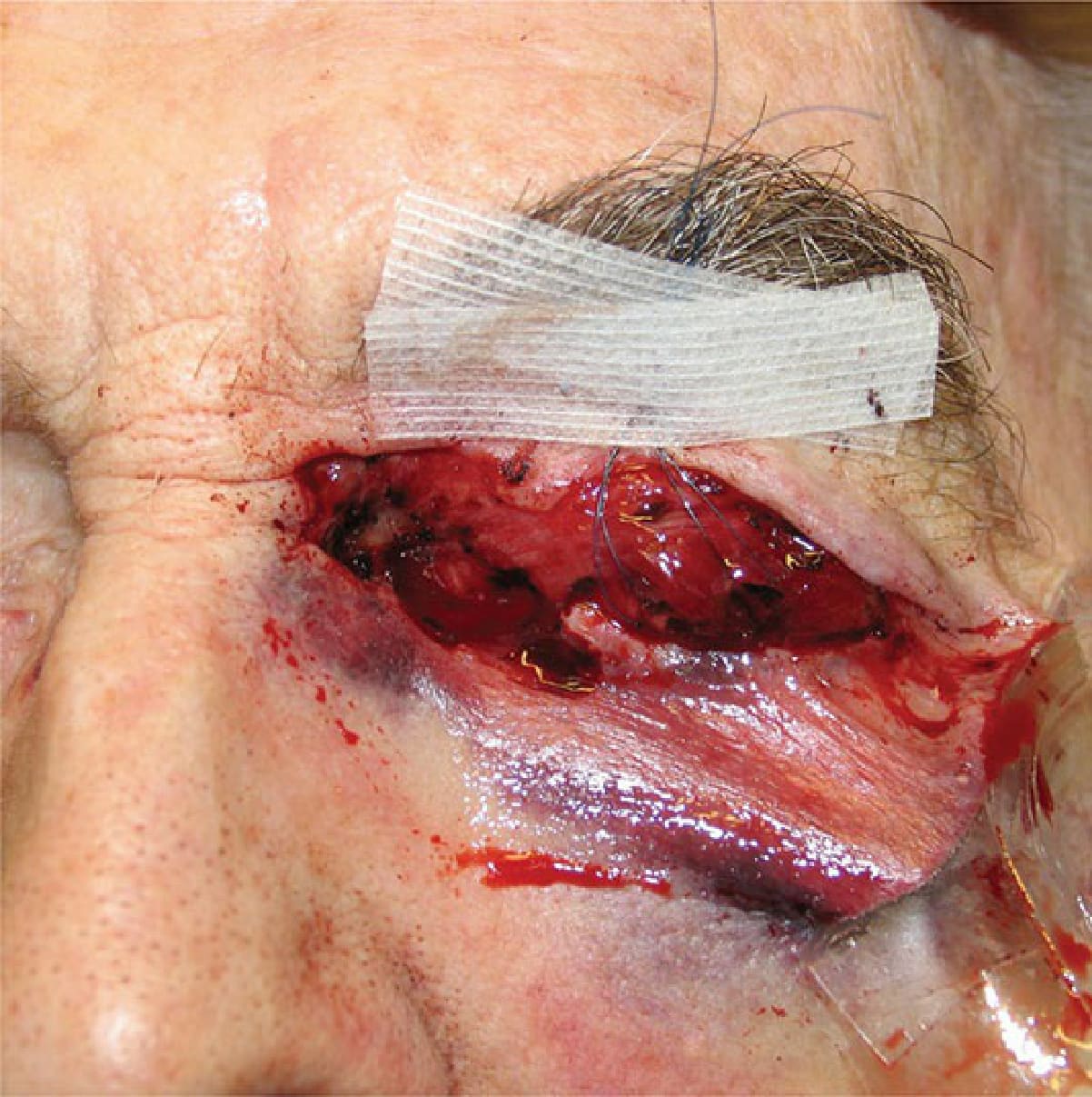
Figure 38-21. Modified Frost suture: A suture is placed through the meibomian gland orifice of the lower lid margin, following the curve of the needle, and exiting the adjacent lid margin through the meibomian gland orifice. The suture is then secured to the forehead with steri-strips.