Hematoma
Hematoma
Hematomas are postoperative bleeding complications that occur if bleeding continues within a closed wound. Hematomas are problematic as they provide a substrate for bacterial growth leading to infections, prevent wound healing, and increase wound tension leading to possible dehiscence.6 Despite optimal perioperative patient management, meticulous surgical technique, and attentive hemostasis, hemorrhagic complications may still occur after dermatologic surgery procedures.98 The risk of bleeding is the greatest in first 24 hours, and is most frequent in the first 6 hours.99 If a hematoma is suspected, the patient should place immediate firm pressure with ice as a first step.98 Any bleeding that does not resolve with pressure within 1 hour, or any rapidly expanding, painful subcutaneous mass should be evaluated on a more urgent
basis.
Rapidly expanding hematomas indicate that there is an active bleed. They typically manifest as an enlarging, ecchymotic, fluctuant to firm mass with acute, throbbing pain (Fig. 36-4). For a rapidly expanding hematoma, the surgical closure must be partially or full opened, and the sources of bleeding identified and stopped.99 Once hemostasis is obtained, the wound can be resutured. After postoperative bleeding is controlled, a pressure dressing should be left in place for a full 48 hours and placement of a drain may be considered.6
Nonexpanding hematomas, or stable hematomas, also commonly develop within the first 48 hours. These hematomas tend to be small and do not compromise tissue viability. No immediate surgical intervention is necessary. Within 2 to 10 days, the hematoma tends to organize into a fibrotic clot, and after 14 days, the hematoma becomes fluctuant and eventually resorbs. Organized hematomas can be treated by incising with a #11 blade along the suture line or 1 cm away from the suture line, with subsequent expression of the contents. Fluctuant hematomas can be aspirated with a large-bore needle. For small hematomas, no intervention may be necessary,99 although even small hematomas can contribute to delayed wound healing and tissue fibrosis.
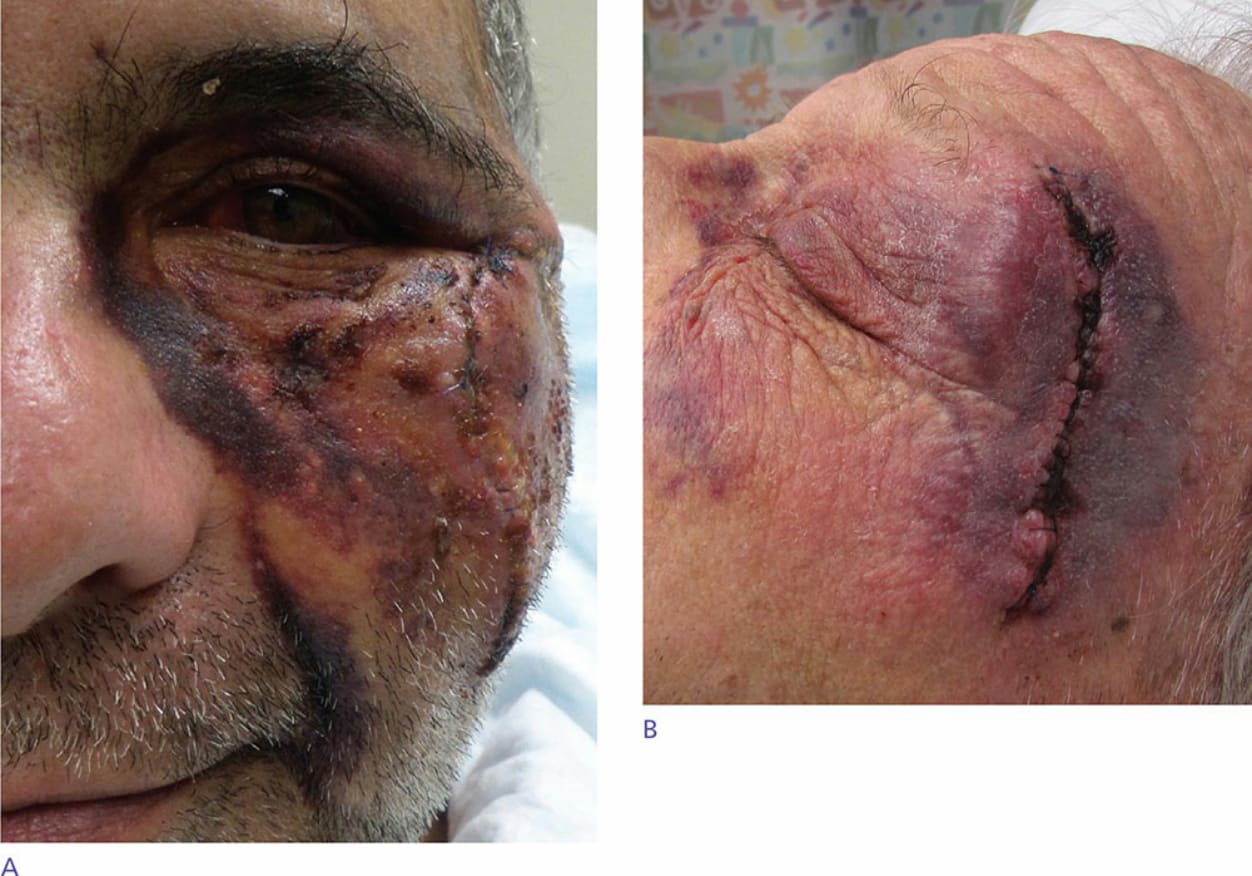
Figure 36-4. (A) Large hematoma of the cheek after rotation flap closure. (B) Stable late hematoma of the temple after primary closure.