Reaction to Anesthesia
Reaction to Anesthesia
Pain Given that the majority of dermatologic surgeries are performed with the patient awake, intraoperative pain management is a key concern. For instance, while MMS is typically well-tolerated, significant intraoperative pain is one of the risk factors for aborting a case prior to achieving clear surgical margins.19 Injectable local anesthesia (LA), most commonly lidocaine, is used for intraoperative pain management in dermatologic surgery. For a full discussion of LA in dermatologic surgery, see Chapter 12.
LA injection itself can be painful due to needle sticks, tissue distension, and burning associated with the anesthetic itself.20 Several techniques can help minimize discomfort during the administration of LA. First, buffering lidocaine with sodium bicarbonate in a 10:1 ratio can decrease injection site pain by alkalinizing the solution toward a more physiologic range.21 By increasing the pH, there is a 10-fold reduction in hydrogen ion concentration, which decreases local irritation and causes a much more rapid disbursement of the anesthetic, resulting in near instantaneous nerve blockade.22,23 Second, various injection techniques can be utilized for pain minimization. These include using a small bore needle (most commonly a 30 gauge), injecting slowly, topical skin cooling prior to injection, using warmed anesthesia, providing distraction stimuli with pinching or vibration, injecting perpendicularly to the skin initially, using as few needle sticks as possible, and ensuring adequate depth and width of the anesthetic.24–28
The use of topical anesthetics prior to LA injection can minimize both patient anxiety and pain. Topical anesthetics may decrease the pain of the needle placement, but will not impact the pain due to anesthetic infiltration. Patients should be provided instructions on safe use of the topical medication and apply the topical anesthetic under occlusion 30 to 60 minutes before arriving for their procedure.29
Topical anesthetics exist in many different preparations and vehicles for delivery. There are numerous commercially available, FDA-approved topical anesthetics for use in dermatology including:
- Eutectic mixture of local anesthetics (EMLA; Astra Pharmaceuticals, Westborough,
MA), which is an oil-in-water emulsion of 2.5% lidocaine and 2.5% prilocaine.
2. Topical lidocaine products, such as Topicaine (ESBA Laboratories, Jupiter, FL),
Lidoderm (Endo Pharmaceuticals, Chadds Ford, PA), and LMX (Ferndale Laboratories, Ferndale, MI).
- Topical S-Caine peel marketed as Pliaglis (Galderma Laboratories, Fort Worth, TX),
which is a eutectic mixture of 7% lidocaine and 7% tetracaine in a cream base and topical S-Caine patch marketed as Synera (Zars, Inc, Salt Lake City, UT), which is a eutectic mixture of 70 mg of lidocaine and 70 mg of tetracaine under a patented heating element that enhances delivery of the anesthetic.
All topical anesthetics have associated risks of cardiotoxicity and central nervous system (CNS) toxicity, which are heightened with prolonged application, the use of inappropriately high concentrations, and application to a large surface area. The prilocaine portion of EMLA can induce methemoglobinemia by oxidizing iron in red blood cells from the ferrous to the ferric state, impairing hemoglobin transport of oxygen.29 Very young patients or patients with glucose-6-phosphate dehydrogenase deficiencies are more susceptible to methemoglobinemia.
Non–FDA-approved, pharmaceutically compounded topical anesthetics should be used with caution. These products typically contain higher concentrations of the compounded anesthetic mixtures than their FDA-approved counterparts and lack appropriate warnings or directions for use. These factors increase both the risk of adverse events and provider liability. Practitioners may wish to limit the use of topical anesthetics to those approved by the FDA, or at least those prepared by reputable compounding pharmacies.29
Local Reactions Tenderness, bruising, and edema are commonly seen after LA infiltration. Edema is often more pronounced in the thinner skin of the periorbital area or the oral mucosa and vermillion lip (Fig. 36-1). Transient motor nerve paralysis can be seen if there is anesthetic involvement of large myelinated nerve fibers. This paralysis may persist several hours after sensory nerves have returned to normal function and patients should be counseled on this potential outcome prior to the procedure.30
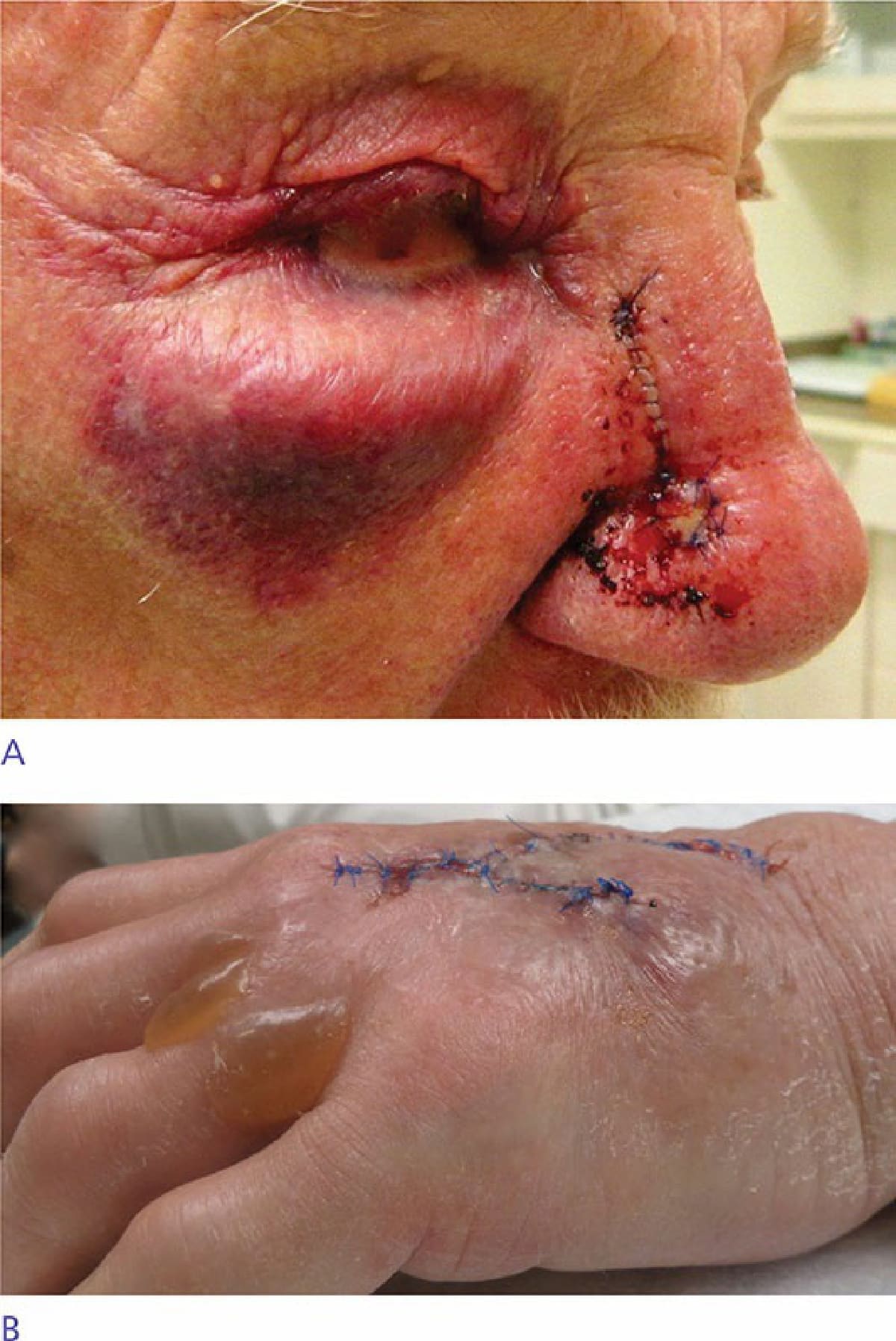
Figure 36-1. (A) Periorbital bruising and edema after Burow’s graft closure on nose. (B) Edema bullae on the hand after rotation flap closure. Reconstruction on the hand often leads to extensive swelling; this can be minimized by wrapping the hand, including the fingers and thumb to the DIP joints, to the mid-forearm with a self-adherent wrap.