Graft selection
Graft selection
The donor site should be selected carefully from an area of skin with similar color,
texture, thickness, background photodamage, degree of sebaceousness, and degree of hair density as the skin surrounding the surgical defect. The graft donor site should be selected from an area where harvesting of the graft will not cause significant functional or cosmetic compromise, and where the donor site scar can be easily concealed. When an optimal match is not possible between the skin appearance of the donor and recipient site, poor cosmetic outcome is more likely to occur.
FTSGs are commonly used on concavities and convexities of the upper two-thirds of the ear, where they can provide excellent topographic and contour restoration.24 Although a combination of a cartilage graft with an FTSG may be necessary for defects where a significant portion of the helical rim cartilage has been removed, FTSGs can frequently be used alone for defects of the remainder of the ear when helical rim cartilage is intact. The preauricular sulcus, postauricular sulcus, and postauricular neck tend to have similar color and baseline photodamage as the ear, making them ideal donor sites for defects of the helix, anterior ear, and posterior ear.
While local flaps are often the preferred reconstructive option for defects on the nose for optimal cosmesis, FTSGs provide a straightforward repair and closure option and an acceptable cosmetic outcome for many patients. For defects on the nasal tip and ala, the conchal bowl is a common FTSG donor site owing to its similar color and sebaceousness. Furthermore, providing the perichondrium is left intact, wounds in the conchal bowl are able to granulate well and heal by second intent with minimal cosmetic penalty.
Defects of the nose that are too large for a conchal bowl graft are often repaired with FTSGs from the preauricular sulcus or postauricular neck where the degree of photodamage is similar to the nose and scars can be easily concealed. For defects of the lower eyelid, FTSGs from redundant skin of the upper eyelid, harvested using a blepharoplasty-type technique, can be utilized with favorable tissue match. Other common FTSG donor sites used for larger defects of the face, scalp, and extremities are the clavicle and inner upper arm (Table 28-1).
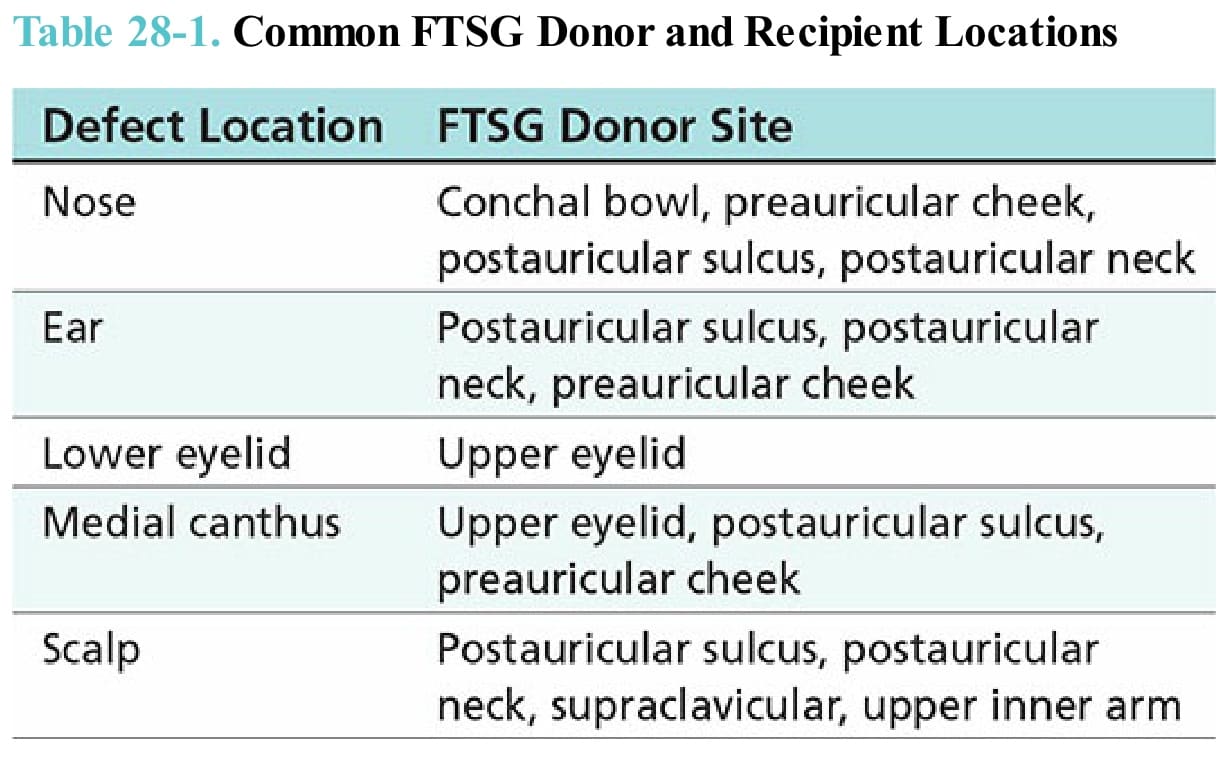
Table 28-1. Common FTSG Donor and Recipient Locations