Technique pearls
Technique pearls
Like all interpolation flaps, it is important to accurately measure the distance the flap needs to travel to reach the defect. In the case of the postauricular interpolation flap, the defect can extend onto the posterior ear if additional reach is needed.
Blunting of the helical rim can occur with this repair. While this does not bother some patients, folding the flap over and using basting sutures can help recreate the helical rim. Blunting of the scaphoid fossa, caused by bridging between the helical rim and antihelix, can also be prevented by the use of basting sutures.
Eversion is most important on the helical rim to prevent notching, and vertical mattress sutures can be helpful in this location (Fig. 13A–G).
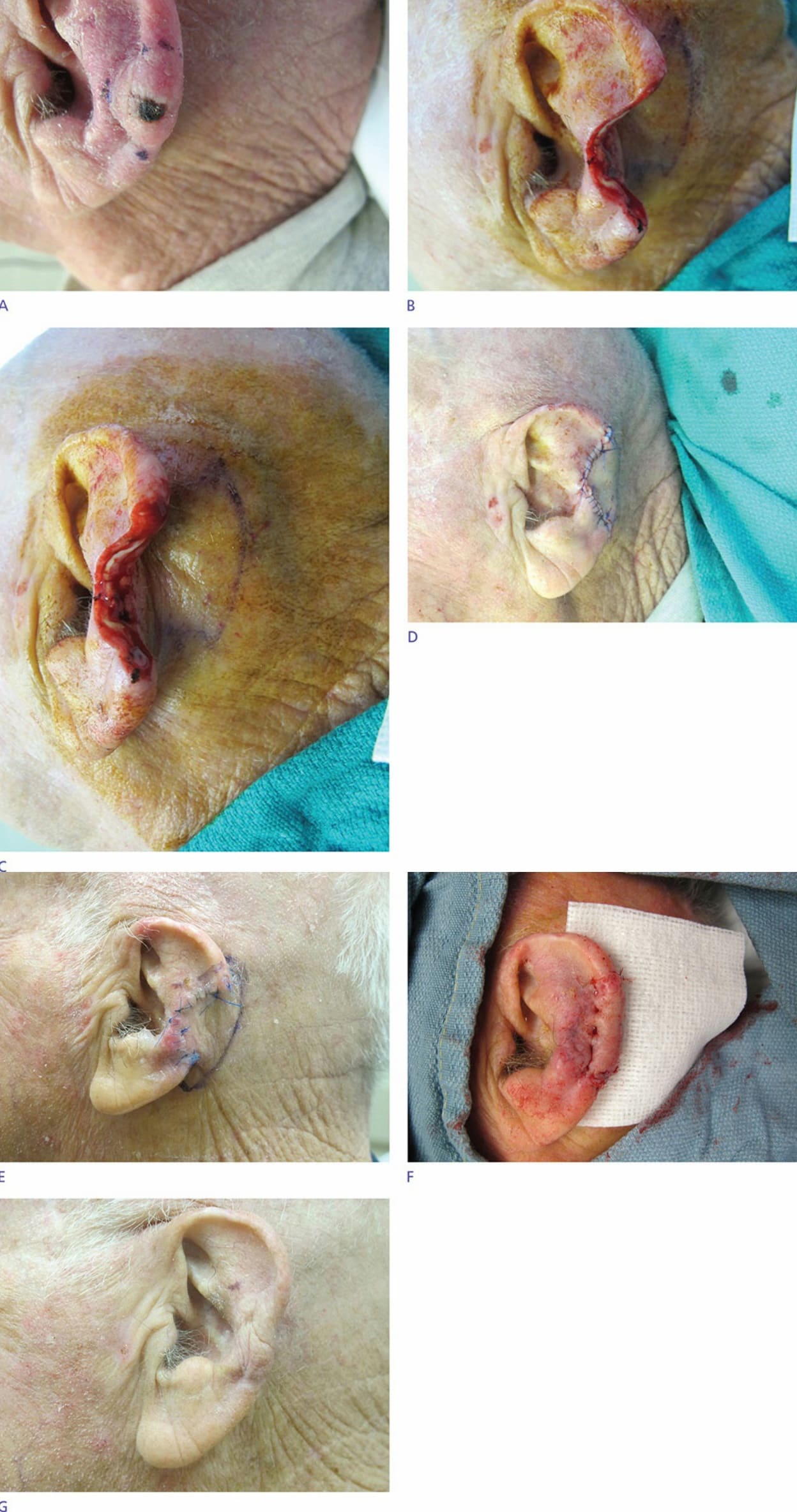
Figure 26-13. (A) Squamous cell carcinoma on the left helix. (B) Full-thickness defect following Mohs surgery. (C) Template for postauricular interpolation flap drawn. (D) Flap sewn into place. (E) Patient returns for takedown 4 weeks later. (F) Division and inset completed. Basting sutures placed to restore contour of helical rim. (G) Postoperative appearance at 6 months.