SCALP
SCALP
Rotation flaps are particularly well suited for reconstruction of defects of the scalp, as limited intrinsic tissue mobility is often encountered. Though traditional single-arm rotation flaps are adequate in many circumstances, at times the added tissue recruitment from additional opposing rotation flaps may be required. A double rotation flap
comprised two traditional rotation flaps taking off from opposite sides of the defect can be useful in areas of high tension. The opposing flaps are undermined in the subgaleal plane and rotated toward each other but in the same clockwise direction around the wound. The advancing edges of the flaps then meet together in the center of the defect (Fig. 22-13).21 When sutured in place, the resultant incision lines form a “Z,” thus explaining its common moniker of an “O to Z flap.” Though used infrequently, triple rotation flaps are noted in the plastic surgery literature for reconstructing large scalp defects. Specifically, Bardach described a technique that incorporates three opposing rotation flaps with backcuts.22 In additional to repairing surgical defects, these flaps can be used to correct areas of cicatricial alopecia.23 Regardless of which rotation flap is employed on the scalp, all offer several advantages. Recruitment of local hair-bearing skin provides excellent match in color, texture, and hair density, and these flaps are relatively easy to elevate owing to the bloodless subgaleal plane of dissection. The primary disadvantage of either a double or triple rotation flap is the sheer quantity of incision lines created. However, the cosmetic impact may be minimal in this location if hair can be used to conceal these lines.
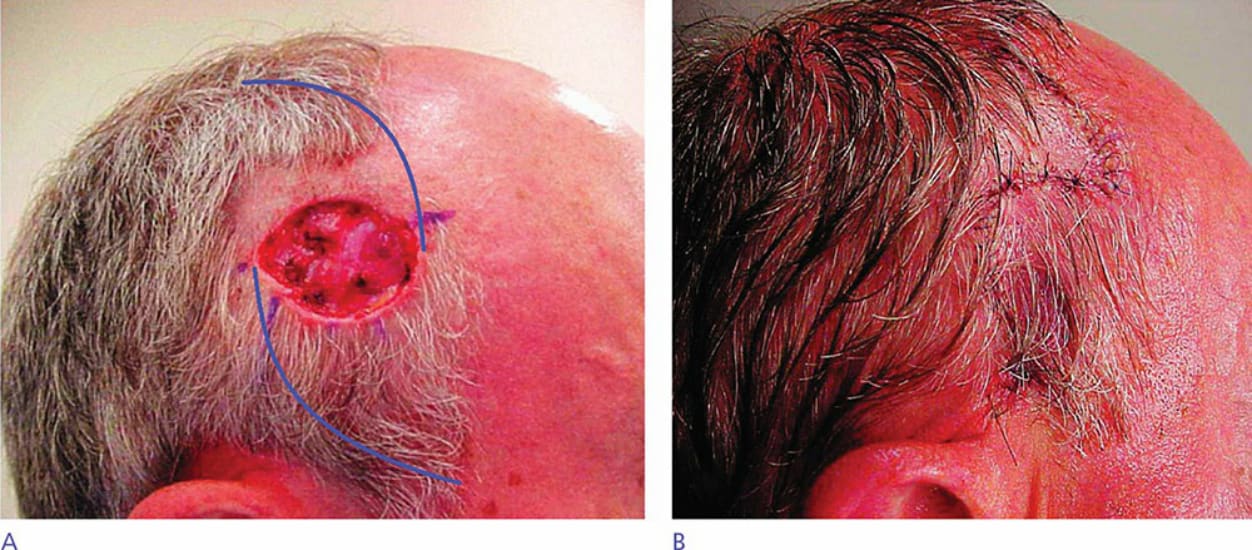
Figure 22-13. O-to-Z rotation flap of the scalp—large defects of the scalp can be closed with opposing rotation flaps in a “Z” orientation. Repair shown with good results and minimal distortion of surrounding free margins.