Deepening the defect
Deepening the defect
When closing defects that arise after Mohs surgery, an initial consideration is whether the surgeon should deepen the defect to a uniform anatomic depth. Excision of tissue at the wound base often removes some obstructive restraint for wound closure, thereby facilitating wound-edge approximation. However, if deepening the defect may also risk functional deficit (i.e., facial nerve paralysis), it should be avoided. Deepening the defect to a uniform depth that corresponds to the anatomic plane for undermining facilitates efficient surgery and ensures that the tissue that “slides” into the wound matches the thickness of the defect.
Enlarging defects to camouflage the scar in cosmetic subunit junctions
While not always necessary or preferred, excising tissue between the surgical defect and a nearby cosmetic subunit junction may be helpful in certain situations. Placing scar lines along cosmetic subunit junctions camouflages scars by hiding them in natural creases and shadows.11–13
On the upper cutaneous lip, relaxed skin tension lines run radially from the vermilion–cutaneous junction, and horizontal scars in the middle of the subunit may be conspicuous. Extending a defect from the middle of the lateral cutaneous upper lip to the vermilion helps to hide the base of the advancement flap in the vermilion–cutaneous junction (Fig. 21-6). In contrast, on the forehead, the surgeon has several options to make incisions along cosmetic subunit junctions or along relaxed skin tension lines. The surgeon may opt to slide the flap along the relaxed skin tension lines (Fig. 21-7), the hairline, or the eyebrow. Wounds on the nasal sidewall may be extended inferiorly to hide the base of the advancement flap in the alar groove. The benefits of adhering to the subunit principle should be weighed against the sacrifice of healthy tissue and the
creation of a larger defect requiring reconstruction.
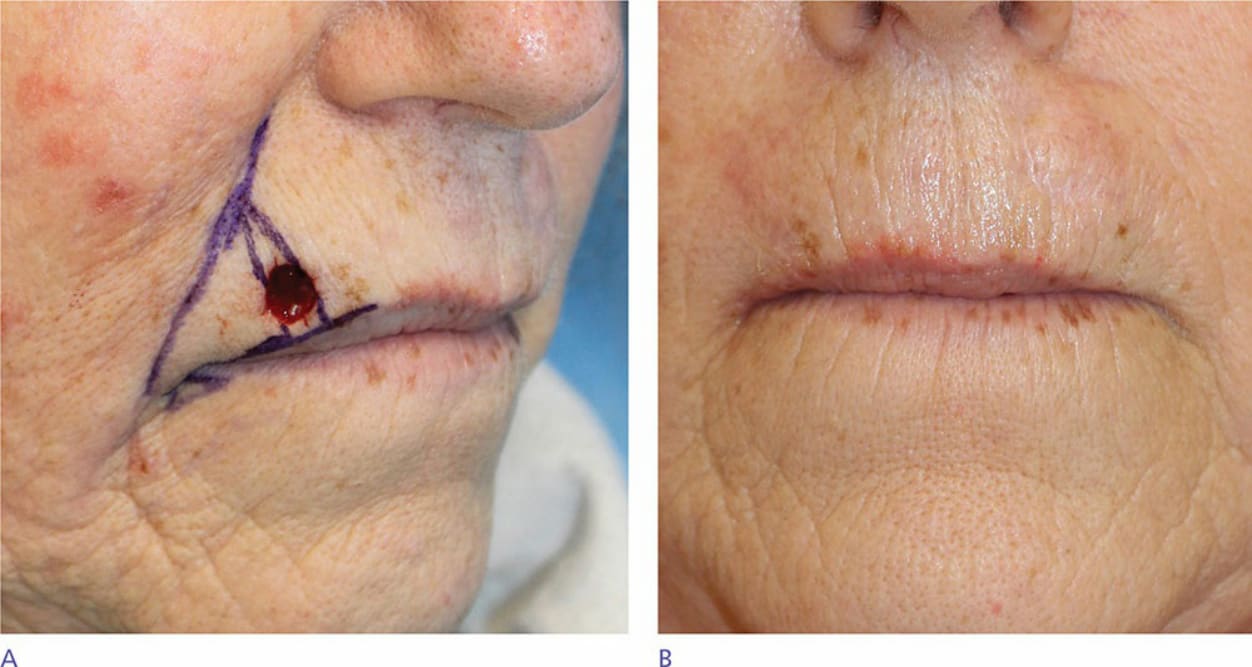
Figure 21-6. Defect on the right upper cutaneous lip after Mohs surgery for a squamous cell carcinoma in situ. An advancement flap was designed. The remainder of the lip cosmetic subunit between the inferior margin of the defect and the vermilion–cutaneous junction was marked for removal to camouflage the scar along the vermillion–cutaneous junction (A). The 8-week postoperative result is shown (B).
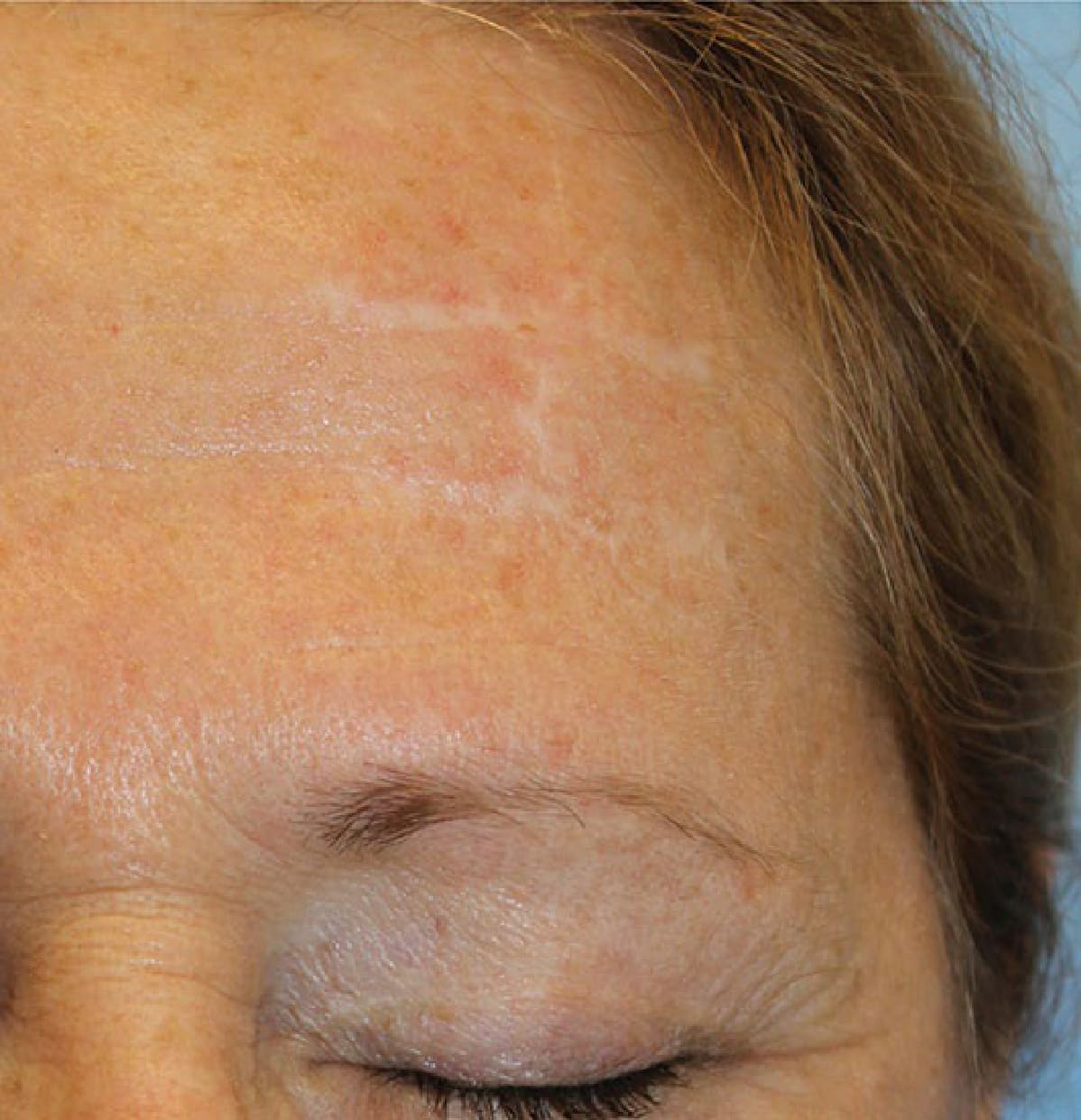
Figure 21-7. Long-term result from a bilateral advancement with incisions along the horizontal relaxed skin tension lines on the forehead. Repair performed by an outside surgeon.