S-plasty modification
S-plasty modification
This technique permits redirection of the closure line of redundant tissue. This is particularly helpful on convex surfaces, such as the extremities, the chin, and the ear which often require length:width ratios much greater than the standard 3:1 to reduce the apical angle for optimal closure. Redirection of the excision has two primary benefits: (1) it guides the suture line from the convex surface onto a flatter surface, thereby mitigating the risk of “chasing” the dog ear on the convexity and decreasing the required suture line length; and (2) as scars tend to depress on convex surfaces, S-plasty redirects the depressive forces onto a flat plane, thereby decreasing the formation of such central indentation.
To perform this procedure (Fig. 19-7), the surgeon will follow many of the same steps as the bilateral-incision technique. However, rather than bisecting the cone to a point aligned with the wound’s axis, a different point is selected either to the right or left of it. The further right or left the surgeon goes, the more dramatic the S-plasty. Curvilinear lines are created and the edges are undermined as needed. As one edge will be longer than the other, the rule-of-halves should be utilized when suturing to decrease the risk of forming another dog ear: the first suture approximates the midpoint of the long arc to the midpoint of the short arc, essentially halving the wound (Fig. 19-7D); the second suture then approximates the midpoints of the subsequent arcs, and so on, and so forth, the strategy continues, successively halving the wound each time until the closure is complete. The rule-of-halves allows the excess tissue of the longer wound edge to be evenly distributed along the entirety of the wound’s closure, minimizing or eliminating the need for redundancy removal.
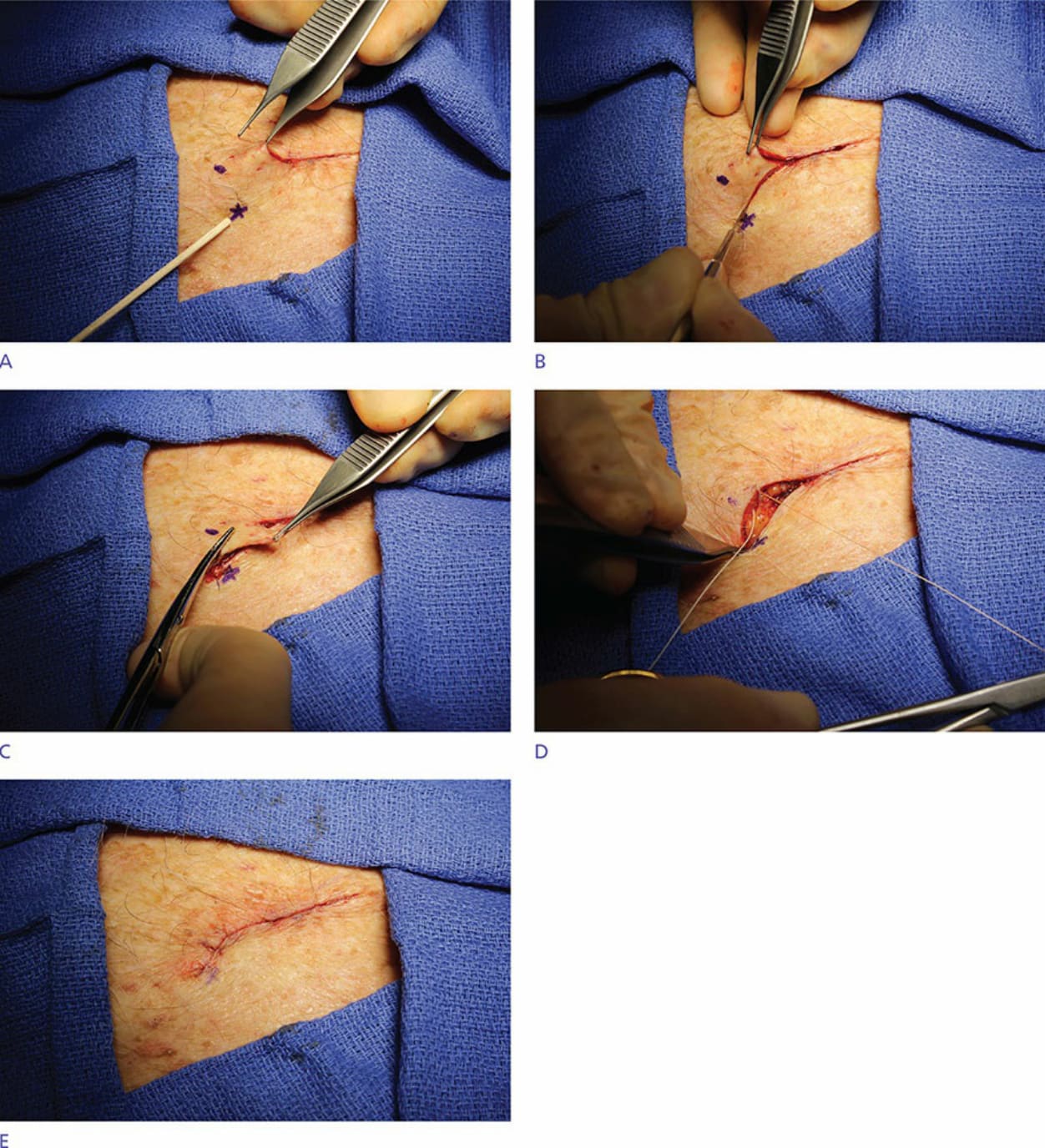
Figure 19-7. The S-plasty modification. In order to exaggerate the curve at the end of the closure, a target point (asterisk) is chosen outside of the standard dog-ear removal cone, lateral to the base of the standing cone (A). A curvilinear incision is made from the end of the existing excision line to the target point (B), and the dog ear is then draped laterally and removed (C). The first deep suture is placed in the center of the nascent dog-ear repair, using the rule of halves (D). Light tension pulling the new wound apex away from the center of the wound is helped to better delineate the precise location of the center of the repair. The final result (E) is a curvilinear repair terminating at the target point.