M-plasty modification
M-plasty modification
This technique may be employed when lengthening of the scar would yield a suboptimal result, commonly encountered when performing surgery around certain anatomic sites, such as the eye or lip, or when the resultant lengthened scar would cross a cosmetic junction. M-plasty is used to shorten the final scar length, and additionally removes less normal skin:9
- Using forceps or a skin hook, grasp the apex of the cutaneous cone and pull lightly
in an outward direction. This maneuver will produce a triangular shape to the cone, with its base aligned with the original wound incision.
2. With the skin tented, note the extent of the redundancy. It may be useful to outline the
base of the cone. Mark a point on each side of the cone’s base that is approximately two-thirds of the length of the redundancy (Fig. 19-6A).
- Incise along the base of the redundancy, connecting one of the points to the existing
wound. Repeat this step with the second point on the other side (Fig. 19-6B). This will result in a flap of skin that resembles a rectangle, which is only attached along one of its long edges (Fig. 19-6C). Note that the apex of the original wound now terminates at the midpoint of the flap’s free edge.
4. Undermine flap of skin, so it can be laid flat on the skin surface.
5. With scissors or a scalpel, excise a portion of the flap by cutting from the midpoint
to the point previously marked in Step 2. Then repeat on the other side (Figs. 19-6D and 19-6E).
6. For good approximation of the tip of the M-plasty, a tip stitch (half buried horizontal
mattress suture) is often utilized. Suturing of the remainder of the M-plasty is performed in a conventional fashion (Fig. 19-6F).
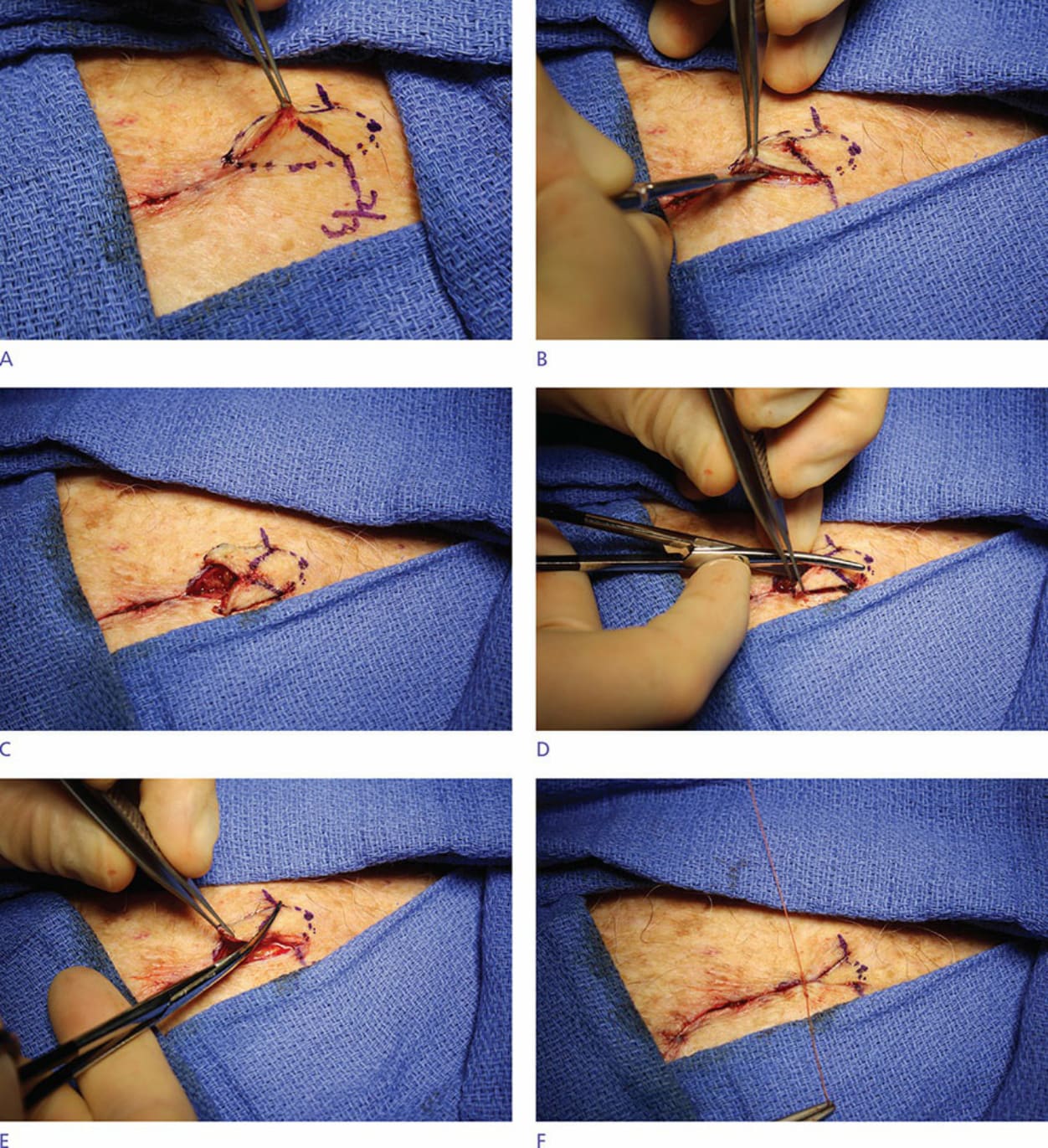
Figure 19-6. The M-plasty technique. The extent of the raised dog ear is delineated (A), and a point 2/3 along the length of each cone’s base is marked. Incise along the base of the redundancy, connecting one of the points to the existing wound (B). Repeat this step with the second point on the other side. This will result in a flap of skin that resembles a rectangle, which is only attached along one of its long edges (C). Next, excise a portion of the flap by cutting from the midpoint to the point previously marked (D) and repeat on the other side (E). A tip stitch (F) is often utilized to secure the tip of the M-plasty in place.