Wound geometry
Wound geometry
The risk of dog-ear formation may be minimized and sometimes completely avoided with some forethought and an understanding of simple geometry. While there are many possible geometric shapes to consider for cutaneous surgery, the fusiform excision has long been established as ideal for linear closure of a wound on a flat surface. The best fusiform excision has symmetric edges of equal length, a length:width ratio of 3 to 4:1 and tapers at the ends to form 30-degree angles.1–4 It should be noted that this shape is commonly referred to as an ellipse, and while this is not geometrically correct, in clinical practice, the terms elliptical and fusiform are often used interchangeably.
The geometric property that contributes most significantly to the formation (or prevention) of dog ears is the length of the wound edges relative to wound width.2 If one visualizes the long axis of the excision as the line which connects the apices, it becomes clear that the sides of the wound are invariably longer than this axis. As closure approaches the apices of the wound, the movement of the edges becomes more rotational, pivoting at the point of the apex and resulting in compression of the periapical skin (Fig. 19-1). When this rotational movement and compression overcome the skin’s elastic qualities, a dog ear forms.1,3,5 Increasing the apical angle increases the rotational movement, subsequently increasing the risk of redundant tissue gathering at the apex.3 To minimize this risk, the excision should have a length:width ratio of 3 to
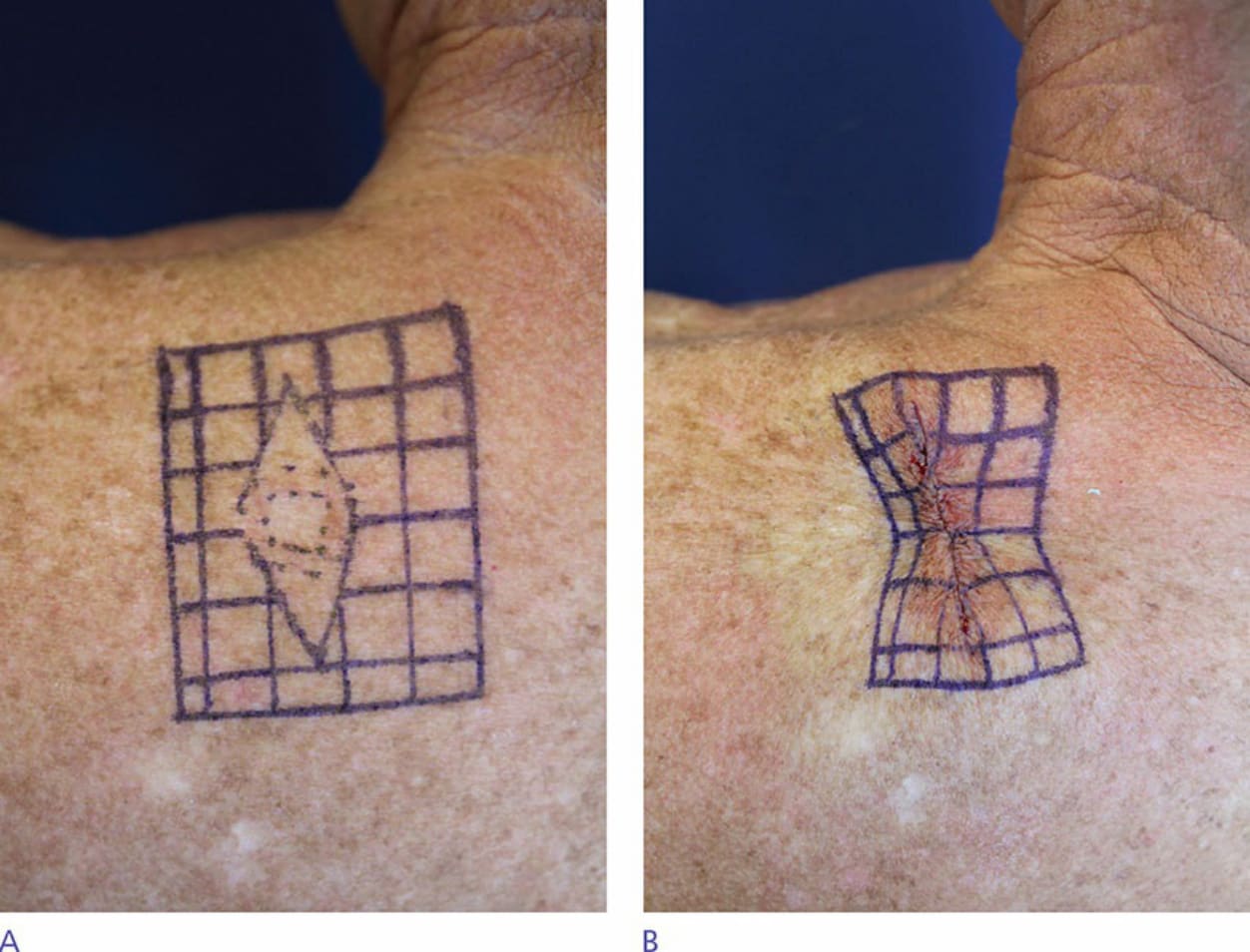
Figure 19-1. In this elliptical excision, the movement at the midpoint of the closure is pure advancement, though the apices rotate slightly as illustrated by the curvature of the lines. This rotational force contributes to tissue puckering and dog-ear formation.