Tissue release
Tissue release
Uniform excision and tissue release are very helpful in elegantly excising tissue and preparing the nascent wound for reconstruction. The tendency to bevel the excision inward at the apices may result in the rowboat deformity, which increases the risk of dog-ear formation unless the excess tissue is separately removed prior to reconstruction. Therefore, excision to a uniform depth and with a uniform angle is desirable. A well-planned excision saves significant reconstructive time by obviating the need to trim overhanging dermis prior to wound closure.
Some authors have referred to the “lagging fat” phenomenon, where the epidermis and dermis tend to retract away from the center of the wound after tissue release, but deep fat—without lateral fibrous attachments—lags centrally and presents a physical impediment to wound closure.41 In clinical practice, there is often a significant lagging dermis phenomenon, where even with a 90-degree perpendicular incision a significant amount of reticular dermis may protrude centrally, particularly in areas with a more robust dermis such as the back. This may be obviated by either excising tissue with a reverse bevel or, after the fact, by trimming the lagging dermis (Fig. 18-22). Importantly, no degree of suturing technique–based correction can solve this physical problem definitively, and investing a few moments in assuring that the wound edges are uniform prior to closure is time well spent.
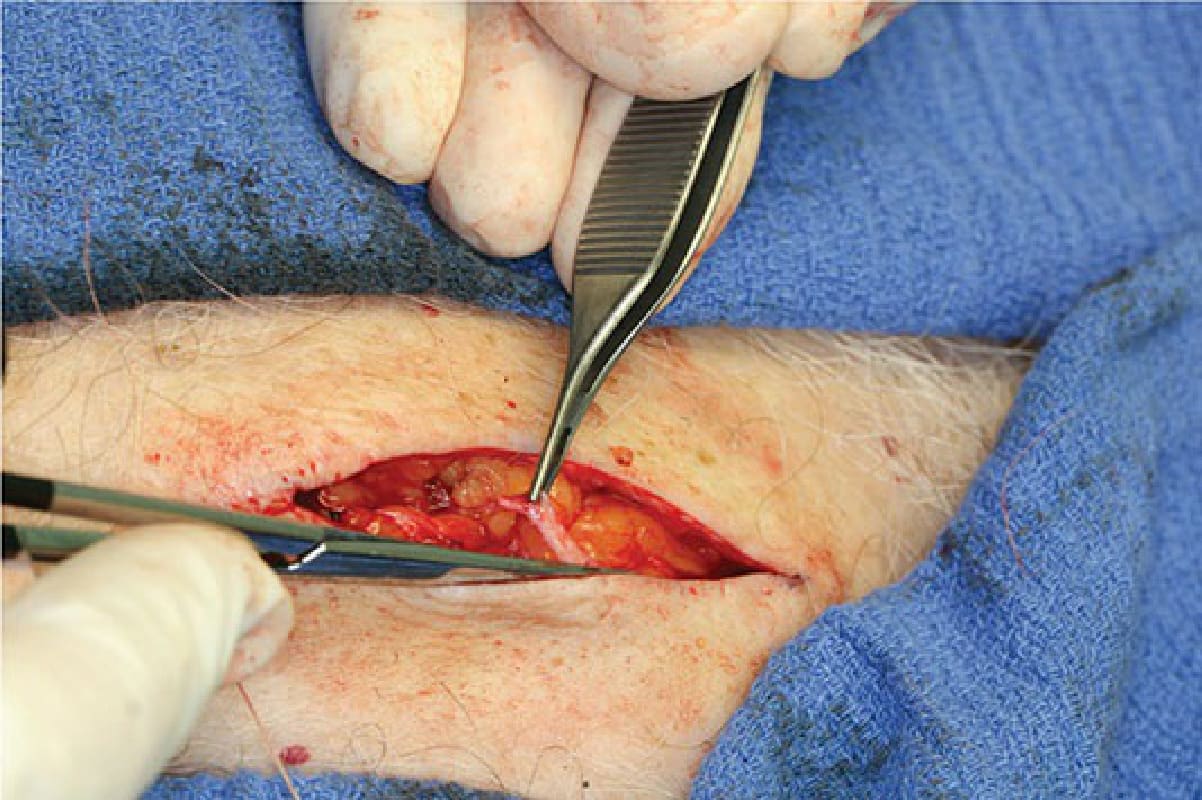
Figure 18-22. Trimming any lagging dermis a critical step that must always take place if dermis is present medial to the epidermal edge.