Principlism
Principlism
Over the past few decades, biomedical ethics, particularly in the United States, has become largely synonymous with principlism. This ethical framework, stemming largely
from the seminal Belmont Report, focuses on four principles considered when evaluating an ethical conundrum (Table 9-1).24 The Belmont Report outlined the principles of respect for persons (autonomy), beneficence (and nonmaleficence), and justice. These principles have been popularized and are now so enmeshed in the modern understanding of bioethics that principlism is in many areas seen as synonymous with bioethics.
First, the principle of autonomy focuses on the premise that individuals should be treated as unique persons, and that their individual autonomous choices should be respected. The corollary of this approach is that those with diminished autonomy (children, prisoners, and others) should be entitled to special protection. Second, the principle of beneficence touches on an obligation by physicians to secure the well-being of their patients. In the Belmont Report, its corollary, nonmaleficence, or not harming the patient, was included under a single rubric. Finally, the principle of justice touches on an underlying need for fairness.
The need for a consistent ethical framework led to the expansion of principlism to the point that the four principles are frequently used as a litmus test for ethical legitimacy. Still, the challenges of this model of applied ethics may be substantial,25,26 and some philosophers have argued that the very model of medical ethics appropriating philosophical doctrines is flawed.11
Casuistry The casuistic method involves the extrapolation of the circumstances of one accepted or paradigmatic case to a new circumstance in order to develop a valid ethical decision (Table 9-2).27–30 This approach, rooted in Talmudic and ancient Christian exegesis, is
frequently applied today in the field of law. Rather than relying on potentially arbitrary principles, the casuistic approach instead turns to paradigmatic cases where the ethical course of action has either already been determined or is prima facie clear. While this approach is predicated on the proper determination of relevant cases,31 its advantage is that it is rooted in an intuitive common-sense approach to ethics.
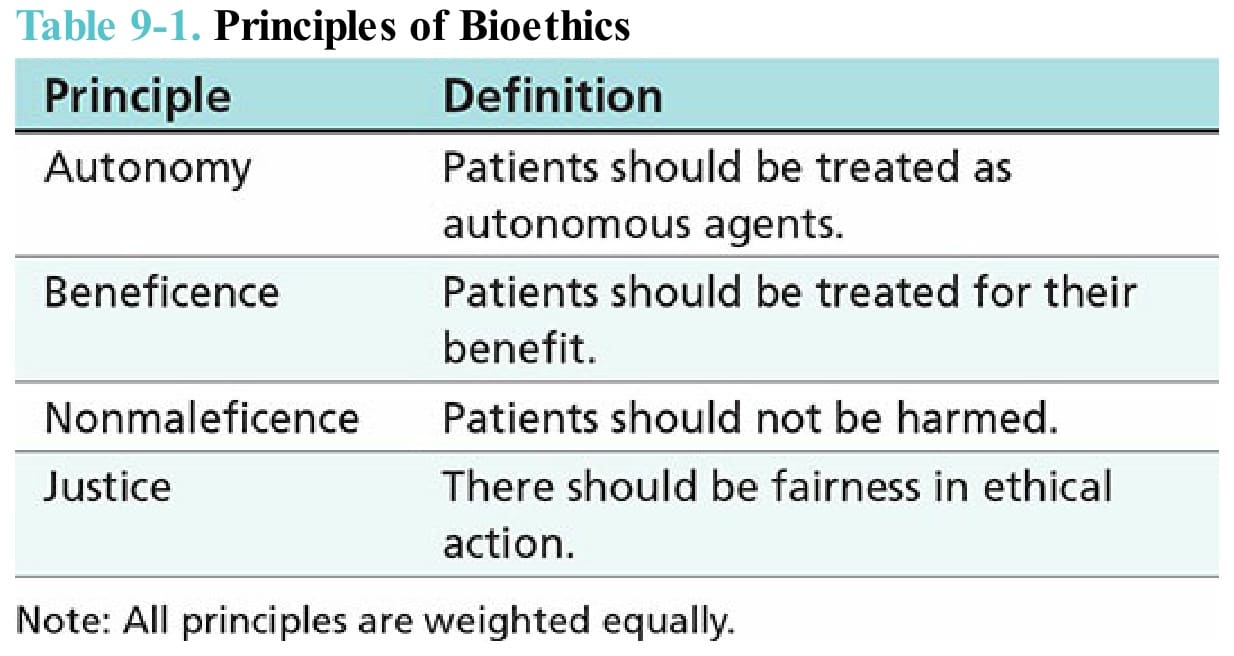
Table 9-1. Principles of Bioethics

Table 9-2. Ethical Approaches