HISTORY
HISTORY
Ethics has been a subject of discussion, debate, and deliberation for thousands of years. While the nascence of ethical and moral theories is often ascribed to ancient Greek philosophers, Mesopotamian writings and codes of law—as well as ancient Greek epic poems significantly predating the development of true Greek philosophy and the Old Testament itself—address fundamental ethical issues.1 Subsequent ancient Greek philosophical writings, particularly those of Plato and Aristotle, formally codified a system of ethical thought.2
In ancient Greece, Socrates spoke at length of fundamental principles that would today be considered utilitarian, with a focus on creating the greatest good.3,4 Aristotle is often considered the father of modern ethics, with his focus on eudaimonia; to Aristotle, appreciating the nature of ethics was a prerequisite to leading the ideal flourishing life.5–10
The origins of bioethics as a distinct field of inquiry may be traced to the 1770 publication of John Gregory’s Lectures on the Duties and Qualifications of a Physician and the subsequent 1803 publication of Thomas Percival’s Medical Ethics (Fig. 9-1).11–14 In Percival’s code—later used as a model for the American Medical Association’s (AMA) first Code of Ethics—he reviewed the ethical underpinnings of practice and duty in an organized fashion. It is no surprise that this occurred in the context of the industrial revolution and rapid developments in the field of medicine, when medical care had shifted from a Galenic worldview to a proto-scientific approach to inquiry.15 Suddenly, the physician had a greater role to play in decisions that could reasonably have a major impact on the patient’s life. Moreover, in the postenlightenment period, the desires of the patient as an individual also took on a more important role. Further, as society evolved from a medieval feudal system to the beginnings of the modern industrialized world that we know today, obligations— between worker and employer, citizen and country, and physician and patient—took on a more urgent role.16 Finally, in the United States in the 1820s, with new world medical education still in its infancy, physicians turned to self-regulation in an attempt to staunch the pressure from charlatans who were felt to be unfairly charging and improperly treating their unwitting patients.1
Modern warfare also impacted the perceived need for a robust grounding in medical ethics. From the bloody US Civil War to the trenches of the First World War and the mass slaughter of the Second World War, the very tools of industrialization that were lauded as harbingers of a truly brave new world were used to take military and civilian lives on a previously unimaginable scale.
With this backdrop, it is no surprise that ethics in medicine took on an even greater
urgency in the 20th century. From Tuskegee to Josef Mengele, physicians—long lauded as working in their patients’ best interests—were suddenly seen, as industrialization was in the centuries before, to represent a powerful force that could as easily harm as help.
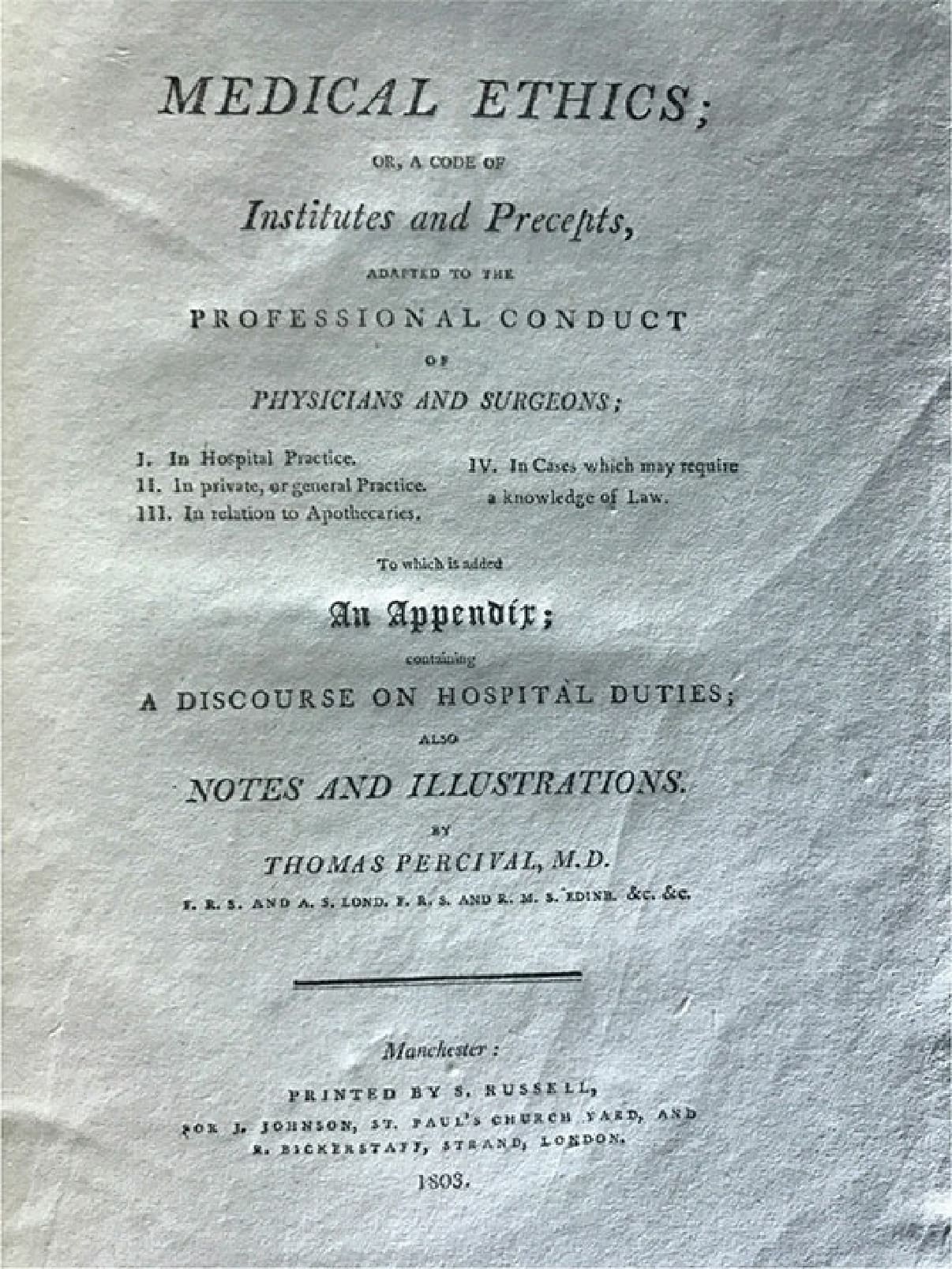
Figure 9-1. First edition of Thomas Percival’s medical ethics.