ANATOMY: IMPORTANCE OF ADIPOSE LAYERS
ANATOMY: IMPORTANCE OF ADIPOSE LAYERS
An HDBC surgeon must have a profound knowledge of anatomy, body proportions, and features that define athletic beauty in both men and women. Without a deep understanding of the muscular structures creating anatomical lines and curves, it is impossible to create shape or contour.
The subcutaneous tissue is divided into three layers: the superficial adipose layer, the intermediate membranous layer (superficial fascia), and the deep adipose layer.5,6
During conventional liposuction, fat is only removed from the deep adipose layer to debulk the body area. In instances where an HDBC candidate began with tight skin and athletic muscle tone, definition can be appreciated with some improvement in contour and further skin tightening (Fig. 60-5). Classical teaching is that removal of the superficial adipose layer is prohibited given an increased risk of postoperative irregularities, seromas, and worsening cellulite; thus, most surgeons avoid treating this layer, which is responsible for the visible muscular etched lines and body shapes created during a high definition procedure.
To treat the superficial layer you must have (1) water-assisted (BodyJet) pressurized tumescence, (2) small (2–3 mm) rotary cannulas, and (3) VASER ultrasound multiringed probes.
The water-assisted tumescence protects the superficial skin vasculature by pressurizing the epinephrine in the fluid. This allows the epinephrine to act quickly and with enhanced longevity and strength to limit bleeding and the potential for skin mottling after aggressive treatment. The hydro-dissection of the water-assisted device creates a more defined and even plane to work in, and hydrates the adipose with less use of total fluid as compared to traditional infiltration, so that more body areas can be treated at a given time with less edema postoperatively.
The VASER technology is essential to soften the fatty layer prior to extraction, creating steam heat that tightens the skin more than power- or laser-assisted devices or hand extraction, and preparing the fat for transfer to areas that give the body contour such as buttock, breast/chest, shoulders, or calves.7 With the multi-ringed (grooved) probes the surgeon can treat the superficial layers evenly and softly with much less risk of irregularity.
The mechanism behind VASER is sound resonance at a frequency that vibrates fat cells causing them to emulsify while other tissue cells remain intact. Electrical energy in the VASER generator is converted to vibrational mechanical energy in the ultrasonic probes. Expanding scopic air bubbles in the tumescent fluid implode, releasing energy that breaks down the structure of adipose tissue without damaging its structure, ensuring it is still suitable for fat transfer.8 Bleeding is minimized and downtime is improved due to less surrounding tissue trauma as compared to standard approaches such as laser-
assisted or power-assisted liposuction (PAL).
Finally, traditional power-assisted devices (e.g., MicroAire) vibrate back-and-forth (e.g., front and back) and extract fat by creating tunnels, increasing the ability to see irregularities and step-offs. Rotary power-assisted devices (e.g., PowerX) vibrate sideto-side in a rotational fashion physically shearing the tissue, allowing the surgeon to physically strip down on the thickness of the fat layer-by-layer without any tunnels. The best comparison of these devices is creating a “Swiss-cheese” look to the fat layer with traditional power-assisted devices versus grating the cheese block with a rotary device.
Liposculpting of the superficial layer is targeted in order to reveal the underlying musculature, to create lines, and to further tighten skin in specific areas. It is an essential component to the HDBC procedure that differentiates it from conventional surgery.
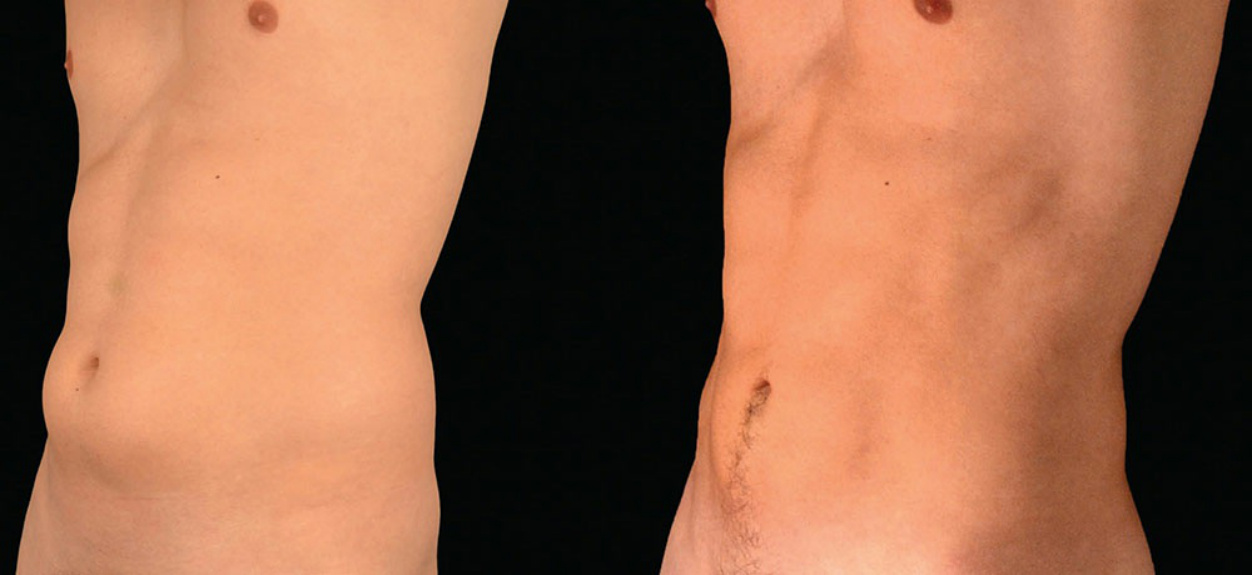
Figure 60-5. Traditional liposuction combined with nonsurgical body contouring. This patient had Coolsculptinginduced paradoxical hyperplasia of the lower abdomen (left) and had local tumescent traditional liposuction followed by 6 weekly treatments of Vanquish radiofrequency and Cellutone vibrational therapy. Results are seen at 3 months post procedure (right).