Burow’s grafts
Burow’s grafts
A Burow’s graft is most commonly used when a wound cannot be completely closed primarily or when closing a wound primarily would distort a free anatomic margin such as the alar rim, lip, or eyelid (Fig. 28-5). The Burow’s graft allows for the use of skin of a similar texture and color. This graft can also be used for defects that span two cosmetic units, allowing the first unit to be closed primarily and the second to be grafted with skin of optimal visual match.27,28
To perform a Burow’s graft, the standing cone removed from the partial primary closure is used to repair the residual defect rather than being discarded. Graft placement technique is the same as that used for the conventional FTSG. In hair-bearing areas such as the mustache, beard, and scalp, Burow’s grafts can be particularly useful to restore normal hair growth within the surgical defect, and this graft may be conceptualized as a localized hair transplant procedure.
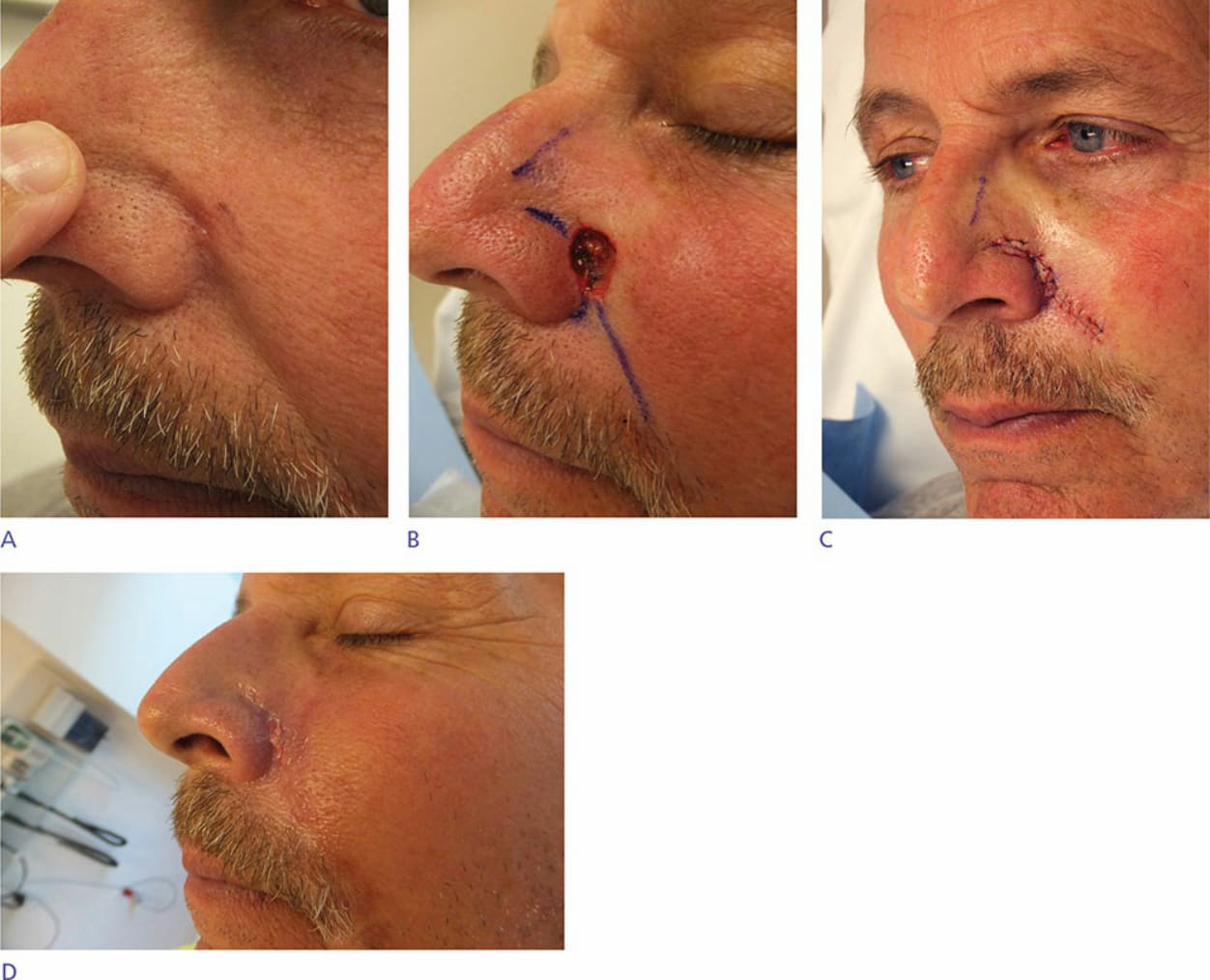
Figure 28-5. A BCC is observed on the left alar crease (A) and a surgical defect is created after tumor extirpation with Mohs micrographic surgery (B). A Burow’s graft is used to close the central portion of the wound in order to avoid alar distortion that would have resulted if the wound was closed primarily (C). Excellent cosmesis is achieved at suture removal (D).