Standing cones
Standing cones
The standing cones (dog ears) created by an advancement flap may be handled in several ways. While the entire standing cone is often moved laterally in one or two
directions (Figs. 21-4A and 25-4B), sometimes a portion of the standing cone is removed at the base of the flap, in a fashion similar to a partial linear closure. A small standing cone or a portion of a large standing cone can be “sewn out” using the rule of halves along the base of the flap (Figs. 21-4C and 25-4D). Alternatively, the standing cone may be removed in a crescentic fashion (Fig. 21-4E),3 especially along curved cosmetic subunit junctions, such as the vermillion cutaneous junction and the nasolabial fold/alar groove.
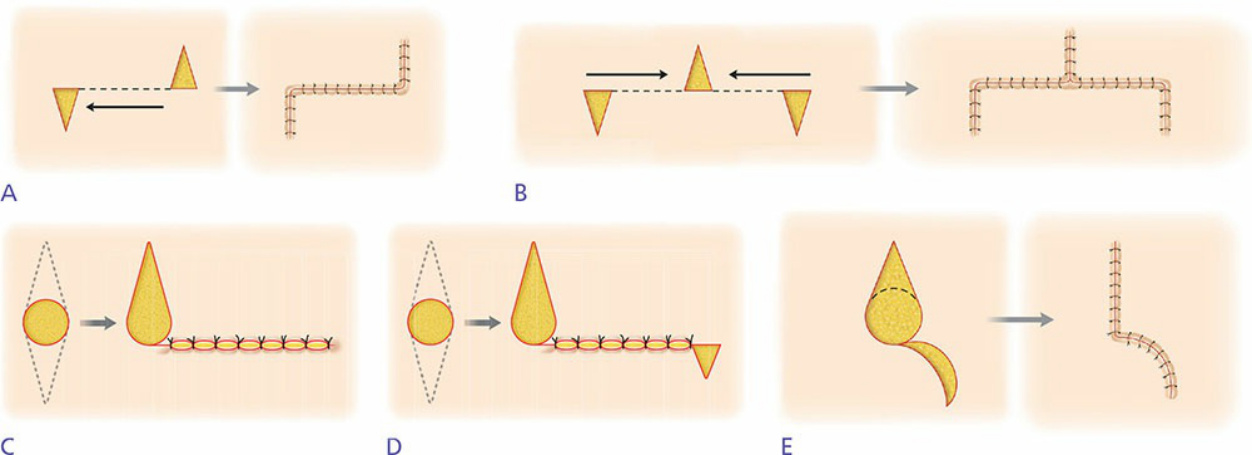
Figure 21-4. Several common methods exist to deal with the displaced standing cones. The entire standing cone may be moved laterally in one direction (A) or split in two directions (B). Alternately, “rule of halves” suturing may be used to handle the standing cone (C), or “rule of halves” suturing may be combined with excision of part of the standing cone (D). Finally, the standing cone can be handled with a crescentic excision (E).