STRESS–STRAIN CURVE
STRESS–STRAIN CURVE
The biomechanical properties of skin must be considered in order to ensure flap viability and success. Like all materials, skin has unique and characteristic biomechanical properties: chief among these are stress and strain. In cutaneous surgery, stress is defined as the force applied per cross-sectional area, while strain is the change in the length divided by the original length when a given force is applied to the skin (Table 20-1).
The nonlinear relationship between stress and strain can be visualized using a stress–stain curve. This nonlinear/nonelastic property of skin is due to its structural components, mainly collagen and elastin. In the elastic phase (Zone I) of the curve, the randomly oriented elastic and collagen fibers within the skin begin to stretch and orient themselves in the direction of the applied force. This initial deformation results in the lengthening of the tissue with minimal force, and is nearly linear or elastic. In the plastic phase (Zone II) of the curve, as force is continually applied, the lengthening continues as additional collagen fibers become aligned parallel to the direction of the applied force. In the breaking phase (Zone III) on the curve, the collagen fibers are maximally stretched and the lengthening becomes limited.3–7 In this final phase, large amounts of force will result in only minimal lengthening of the tissue due to the inextensible nature of fully stretched collagen fibers.8 Understanding this stress–strain curve is essential to flap design as high wound-closure tension, as seen in Zone III of the curve, increases the risk for tissue necrosis and flap failure (Fig. 20-2).
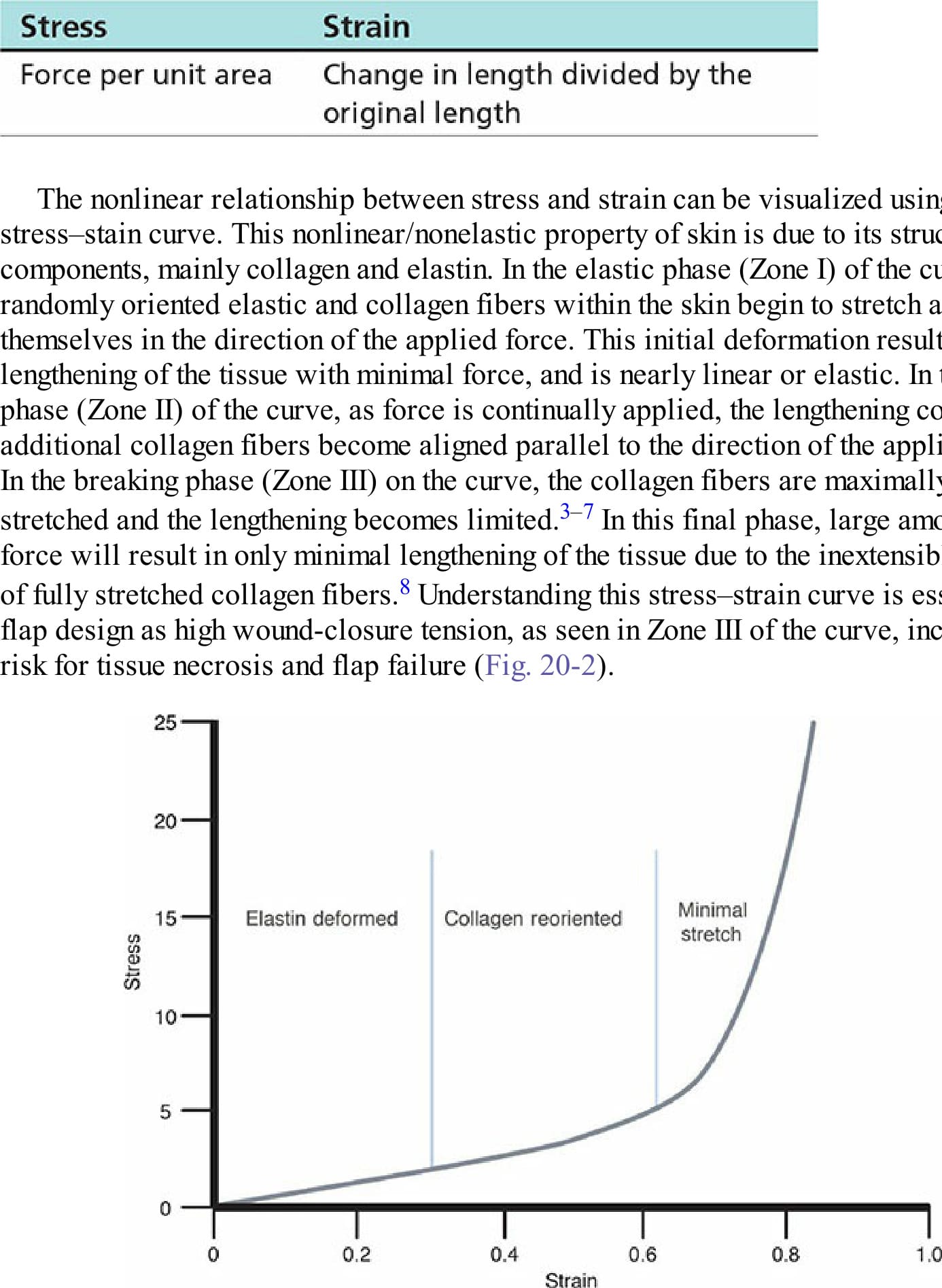
Figure 20-2. Stress–strain curve demonstrating the nonlinear properties of skin when stretched. Initial lengthening occurs with minimal force during the elastic phase (Zone I), progressive lengthening occurs during the plastic phase (Zone II), and lengthening ceases despite additional force during the breaking phase (Zone III).
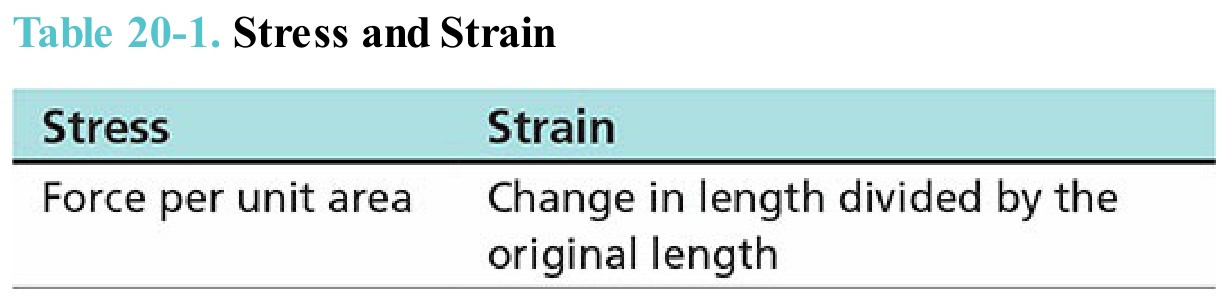
Table 20-1. Stress and Strain