STRUCTURE
STRUCTURE
All local anesthetics have similar structures and contain three parts: the aromatic ring, the intermediate chain, and the terminal amine portion (Fig. 12-1). Any alterations of the anesthetic agent can affect its pharmacological properties. The aromatic ring, a lipophobic component, is responsible for the diffusion of the anesthetic through cell membranes and nerve sheaths.6 The intermediate chain binds either an ester or an amide containing between three and seven carbon equivalents, and is responsible for its mode of action.7 Disruption of the intermediate chain is responsible for local anesthetic metabolism and the reversible nature of these agents.7 The amine terminus can arise in a tertiary form that is lipid soluble or a quaternary form, which is water soluble and positively charged.8 It is this same terminus that is thought to bind to the sodium channel and determine the length of action of the anesthetic.7
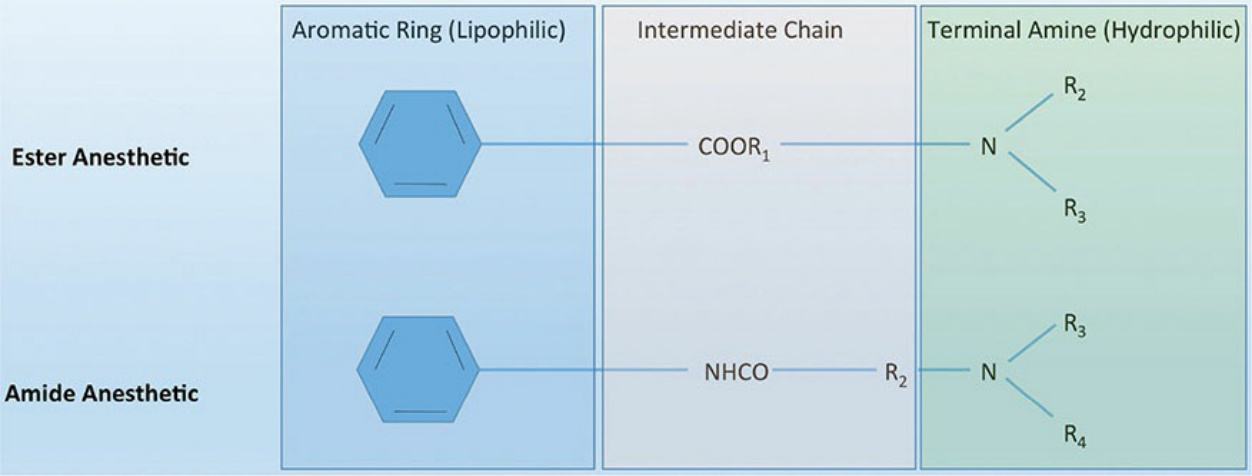
Figure 12-1. All local anesthetics have similar structures and contain three parts: the aromatic ring, the intermediate chain, and the terminal amine portion.